
There is a quiet revolution happening in the way people want to relate to brands, and it has nothing to do with better ads, slicker campaigns, or more sophisticated targeting. It has everything to do with something far simpler and far more human: the desire to see what is really going on.
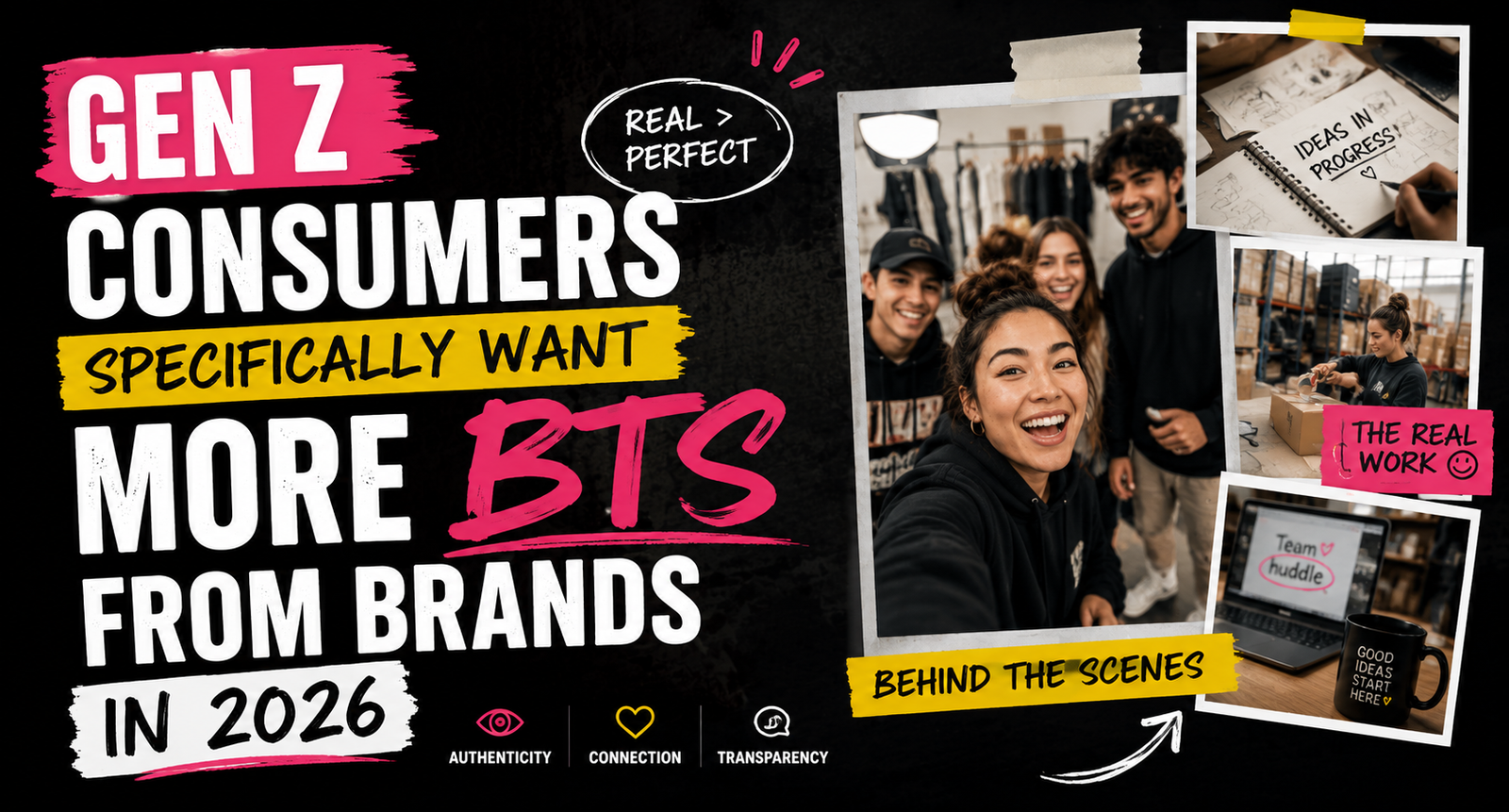
Behind-the-scenes content — raw, unpolished, process-driven glimpses into how a brand actually operates — is surging in demand. And the numbers are hard to ignore. In 2026, 26% of Gen Z consumers are actively asking for more of it. That is not a niche preference. That is a cultural signal, and brands that fail to read it are leaving enormous amounts of trust, loyalty, and revenue on the table.
Table of Contents
ToggleThe Era of Performative Polish Is Over
For years, the dominant brand aesthetic was aspirational to the point of being untouchable. Products floated against white backgrounds. Founders gave carefully rehearsed interviews. Campaigns were architected by committees and filtered through legal before a single pixel went live. Everything looked expensive, intentional, and perfect.
The problem with perfect is that nobody believes it anymore.
Gen Z grew up watching influencers blur the line between personal and promotional so aggressively that they developed an almost supernatural ability to detect inauthenticity. They have seen enough sponsored content, enough “organic” endorsements, enough brand voices carefully designed to sound spontaneous, that their default setting is skepticism. You do not earn their trust by looking good. You earn it by being real.
Behind-the-scenes content is one of the most direct routes to that reality. When a brand shows the actual factory floor, the genuine team meeting, the product that did not work before the one that did, it is making a bet on transparency — and Gen Z rewards that bet.
What BTS Content Actually Does for a Brand
It builds credibility at the source. When consumers see how something is made, sourced, or designed, they are not just entertained. They are being given evidence. Evidence that the product is real, that the people making it care, that the claims on the packaging have a foundation. In an era when greenwashing, airbrushing, and AI-generated testimonials have made people deeply suspicious of polished brand communication, showing the actual work is one of the most persuasive things a brand can do.
It creates emotional investment. There is a psychological phenomenon sometimes called the IKEA effect — the tendency for people to place higher value on things they have had a hand in creating. BTS content replicates a version of this at scale. When a follower watches a small business owner pack orders by hand at midnight, or sees a chef develop a dish through five failed iterations, they feel connected to the outcome. They are no longer passive consumers. They are witnesses to a journey, and that changes their relationship to the brand entirely.
It humanizes the people behind the product. Brands have spent decades trying to build personalities without faces. Behind-the-scenes content reverses that architecture. It puts people front and center — the designers, the warehouse team, the founder arguing with herself in the car on the way to a meeting. These are the moments that make a brand feel less like a corporation and more like a community of humans trying to make something good.
It generates the kind of engagement that algorithms reward. Authenticity drives comments, saves, and shares at a rate that produced content rarely matches. When people feel they are seeing something real, they respond to it in kind. They tag friends. They say “this is exactly why I support this brand.” They screenshot and repost. The algorithmic implications of that behavior are significant, but more important than reach is the quality of the relationship being built.
The Specific Hunger Gen Z Is Expressing
The 26% figure is worth sitting with for a moment. One in four Gen Z consumers is not just passively receptive to behind-the-scenes content — they are specifically requesting more of it. That is an unusually active expression of preference from a generation that is more likely to simply disengage from content that does not serve them than to articulate what they want instead.
What is driving this? Several converging forces.
The first is values alignment. Gen Z is the most values-driven consumer cohort in history. They want to know whether the companies they support treat workers fairly, source ethically, operate sustainably. Behind-the-scenes content is one of the few formats that can answer those questions without feeling like a corporate responsibility report. Seeing the warehouse, the team, the supply chain — even imperfectly — is more persuasive than any sustainability pledge.
The second is the creator economy’s influence on expectations. Gen Z has grown up consuming content from individual creators who share everything — their creative process, their mistakes, their mental health struggles, their revenue numbers. That radical transparency has recalibrated what an audience expects from anyone trying to earn their attention. Brands are now competing not just with other brands but with individual humans who have no PR department and no brand guidelines. The brands winning that competition are the ones willing to operate with something closer to human-level openness.
The third is a reaction to overstimulation. In an environment saturated with hyper-produced content, simplicity has become its own form of luxury. A shaky phone video of a team celebrating a product launch, a time-lapse of a studio being set up, a founder talking directly to camera without notes — these formats cut through precisely because they do not look like everything else. The rawness is not a flaw. It is the point.
What Good BTS Content Actually Looks Like
Brands sometimes misunderstand behind-the-scenes content as simply lower production value. It is not. The absence of a production crew does not automatically make something feel authentic, and authenticity is not the same as being unfiltered to the point of incoherence.
Good BTS content has a point of view. It chooses which part of the process to share and why. It invites the audience into something specific — a decision being made, a problem being solved, a person doing something they clearly care about. It does not overshare for the sake of appearing relatable. It shares with intention.
Some of the most effective formats include process documentation — watching something go from concept to finished product. Team and culture content — not staged office parties, but real moments of collaboration, disagreement, and resolution. Founder diaries that show the actual emotional texture of running a business. Failure and recovery content that normalizes the messy middle of building something. And reactive content — when something goes wrong publicly, brands that go behind the scenes to address it directly build more trust than those that issue polished statements.
The Cost of Ignoring This
Brands that continue to default to aspirational, high-gloss content are not just missing an opportunity. They are actively eroding the trust of the most commercially significant generation of the next two decades. Gen Z’s spending power is growing, but more importantly, their influence over the purchasing decisions of older generations is already substantial.
The brands they trust will be the brands that let them in. Not performatively. Not with a BTS content series that still feels like a campaign. But genuinely, consistently, with the kind of ongoing access that says: we have nothing to hide, and we think you deserve to see how this actually works.
That is not a content strategy. That is a relationship. And relationships, built carefully and maintained honestly, are the only thing in marketing that compound over time.
The curtain is coming down. The only question is whether your brand is ready to step out from behind it.