Key Takeaways
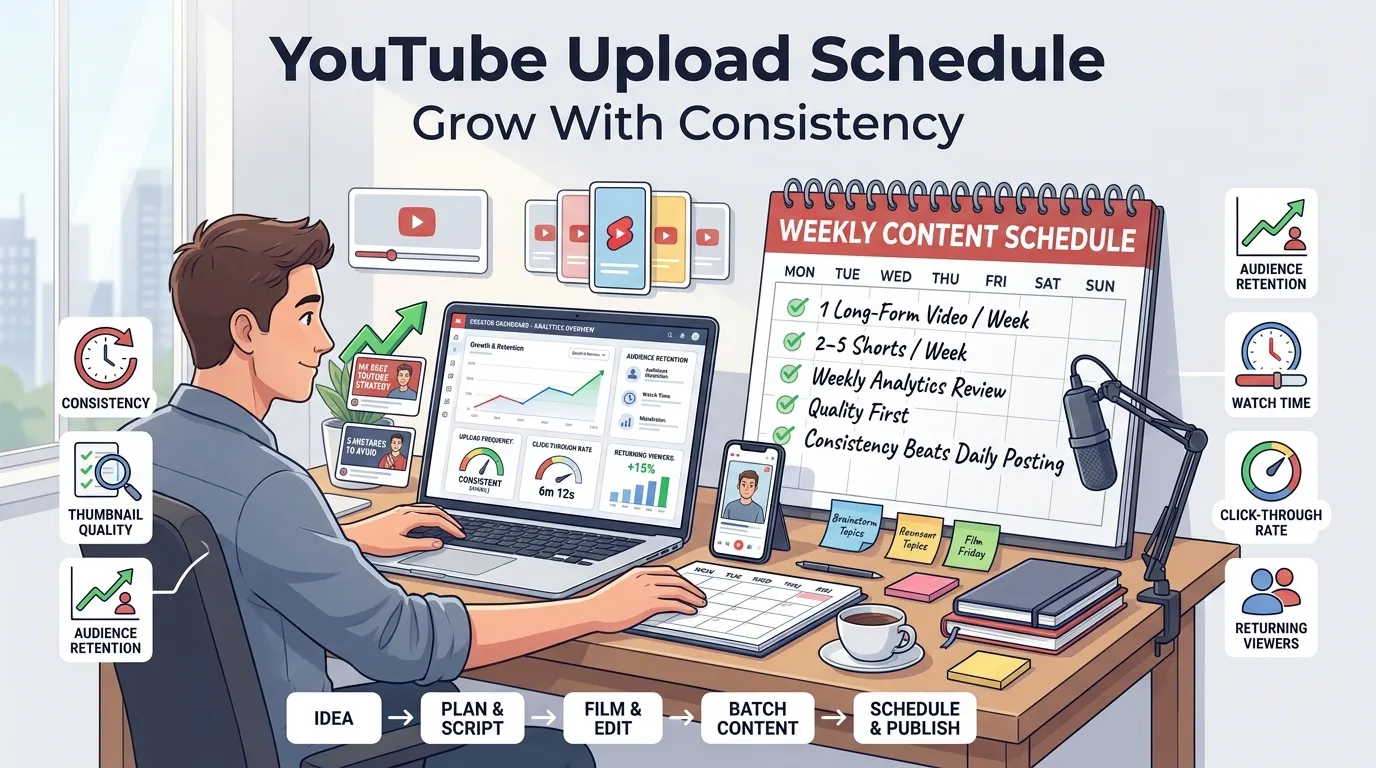
- If you’re able to maintain high quality, upload 1 long form video per week.
- Uploading 2-5 YouTube short per week to experiment and test campaign concepts to better reach users.
- For most channels it is not required to upload content every day.
- Repetition is preferred: More repetition equals quality as viewers and the Algorithm will respond more to quality repetition.
- 1-2 longer videos per week could develop the Educational and Tutorial Channels.
- Gaming YouTube Channels have a greater opportunity to post more frequently as the gaming niche has an easier time of batching.
- In busy news cycles, it’s important for News and Commentary Channels to post quicker.
- Lifestyle and Vlog Channels are expected to safeguard the quality of their channel and audience retention.
- Utilize YouTube Analytics to see the behavior, retention and best type of times.
Intro
The recommendation for the question of “How Often Should I Upload To Grow On Youtube” is 1 solid long-form video a week, in addition to 2–5 YouTube Shorts a week, as long as you maintain the same quality of video. It takes anywhere between 7 and 14 days for a new channel to begin producing 1 long-form video. One to two long form videos every week is possible with small channels.
Two to four videos can be posted per month per brand and Brands can be active on Shorts and Community posts.
Yes, it’s important how often you upload content on YouTube, but it’s not enough to have frequent uploads; there has to be useful content, too.
YouTube tells us that the recommendation is based on viewer behavior, the amount of viewers time and likes/dislikes or “not interested” signals and satisfaction surveys. The ultimate frequency of posting will be the one that allows you to post videos that individuals click through, view and return to.
The Algorithm Truth About Upload Frequency
The Algorithm Truth is Simplicity YouTube don’t develop a channel just due to the status of the creator posting more. The growth of YouTube is from viewer response. Thus a video receiving high click rates, views, higher YouTube Audience Retentions and positive engagement is more likely to be seen by more visitors.
If there is still room for more videos that will be useful, understandable and well-packaged, then additional posting could aid. More substandard videos published can teach the viewers to ignore your channel.
Understanding the Importance of Posting Frequency on YouTube
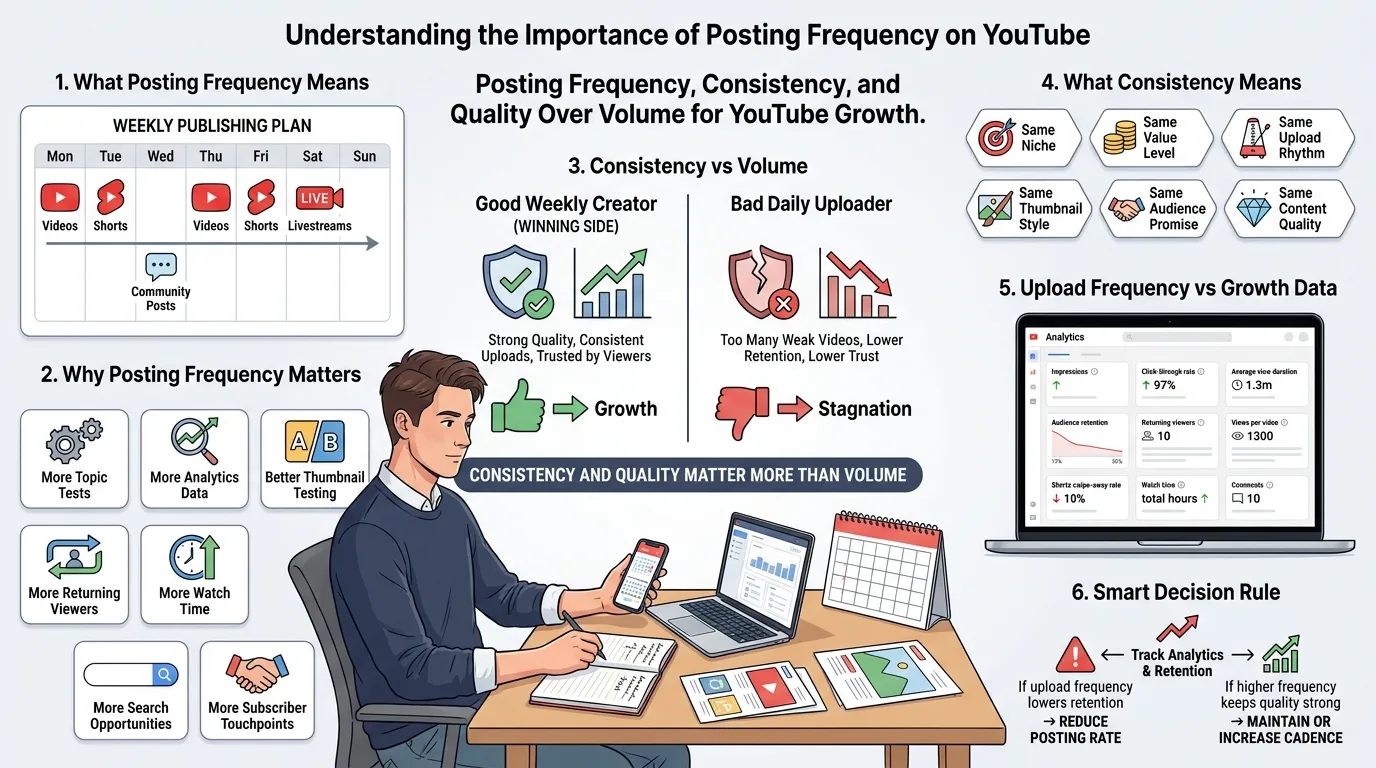
YouTube posting frequency is the pace at which you publish videos, Shorts, livestreams and Community posts. Posting Schedules inform the viewers when the new content is going to be available and also assists in production planning.
Does Posting Frequency Matter for YouTube Growth?
Yes, the frequency of posting is important to grow YouTube, but it’s all about the quality, retention and topic demand. Regular uploading documents provides YouTube with extra substance to check and extra factors to come back to.
How often you post can assist you with:
- More topic tests
- Make sure that you enable more data in YouTube Analytics.
- Improved thumbnails, there are now more opportunities to improve thumbnails.
- More returning viewers
- Opportunities for more watch time.
- Additional places to put search terms.
- More subscriber touchpoints
But there’s nothing worse than a bad every day uploader than a good weekly videomaker.
Why Consistency Matters More Than Posting Volume
Repeat, repeat, repeat – Consistency is the name of the game and consistency promotes trust. When your audience thumbs up your channel, it is with the anticipation of the future upload, the same one that you enticed them with by posting the prior one.
Consistency means:
- Same niche
- Same value level
- Same upload rhythm
- Same thumbnail style
- Same audience promise
- Same content quality
Volume = lots of videos! If every video still is still needed, then volume can be helpful.
The Data: Upload Frequency vs Growth
The optimum frequency growth pattern for uploads will be different for each channel. The decision should be taken by YouTube Analytics.
Track these numbers:
- Impressions
- Click-through rate
- Average view duration
- Audience retention
- Returning viewers
- Applicable only to the subscribers of the newspaper, who received per video.
- Views per video
- The number of short overtaking and swiping away the shorts.
- Watch time
- Comments
If the number of uploads causes average retention to decrease, decrease the rate at which the uploads are performed. If higher cadence helps to drive up more uploads with no significant reduction in quality, then maintain the higher cadence.
Factors That Influence How Often a YouTube Post Should Go Live
There is no right and wrong size for your YouTube posting schedule — it all hinges on your objective, resources, niche and the actions of your audience.
Your Goals (Brand Awareness, Lead Generation, Community Building)
You’ll need to think about exposure on an ongoing basis for brand awareness. With lead generation, there’s no need for such a high volume of videos, but quality does matter. A variety of videos, Shorts, livestreams, and Community posts make up community building.
Frequency as per goal:
| Goal | Best Frequency |
|---|---|
| Impression | 1–3 short video per week + 2 long form video per month |
| Lead generation | 2–4 strong long form videos here and there, monthly. |
| Community building | 1 video done in long form per week + 1 monthly livestream |
| Videos | 1–2 long form videos per week |
| Discussion about their products | 2 – 4 times a month |
| Creator growth | 1 long form video and 3-5 shorts/week |
Your Resources and Production Bandwidth
The cadence of upload is determined by the bandwidth selected at production. A user of a limited edit capacity should NOT be copying a team channel.
Go through and view your capacity and confirm it is correct for the week:
- Research time
- Script time
- Recording time
- Editing time
- Thumbnail time
- Upload time
- Promotion time
- Analytics review time
If a channel has scripted material, the upload frequency is kept lower, than a channel that has quick reactions clips.
Your Content Strategy and Niche
It depends on your content strategy for how often you should post. For a channel that breaks news, it is possible that there will be daily uploads. On a documentary channel, one powerful video every month will suffice.
Use niche expectations:
- ESSENTIALS: 1-2 videos a week.
- Rest of the week: Computer time up to 20 mins/night
- News: daily throughout stories that are active
- Vlogs: 1–3 videos per week (may or may not be all three in a row)
- Business: 1 video per week (must use text in video)
- If original: two-four videos per week, faceless channels:
- Non-brands: 30 seconds to four minutes each video – the longer is best.
Your Audience’s Viewing Habits
The true schedule is one that YOU set for your audience. The Audience tab on YouTube Analytics provides information about your audience, such as their age and gender and how they watch the content. Apply that information and learn about the times when users are active and what kinds of content they come back to view.
May be viewed by students at night. You can perform before a professional audience pre-work, lunch break or weekends. Geographic optimization in the audiences means it is a must have for a global channel.
YouTube Posting Schedule by Channel Stage
By creating a posting schedule, based on the channel stage, creators can put measured steps into their channel to prevent burnout and create their channel in stages.
Starting Out: Realistic Upload Schedules
These should be performed starting pace, the pace that can be started on and repeated for 90 days.
Best beginner schedule:
- 1 long form video per week or biweekly
- On average, 2-3 YouTube Shorts are posted per week.
- 1 Post/Week (when available) from 1 Community
- Up to 1 livestream per month (provided there is a sufficient volume of channel active audience)
Before creators should increase their volume, they should first hone their skills in titling, creating thumbnails, holding an audience and editing.
Growing a Small Channel
Once they’ve stumbled upon a topic that is working, a small growing channel can boost output.
The best small channel schedule is the following:
- Once or twice weekly, long form video(3 – 5 mins)
- 3–5 Shorts per week
- 1 livestream every 2–4 weeks
- One – two communities posts per week
Only increase when video quality isn’t decreased.
Established Channels: Meeting Viewer Expectations
Demand expectations of regular viewers of an established channel should be retained. Satisfactory upload schedule is valued by the subscriber.
Adheres to effectively planned channel schedule:
- Same fast niches of 2–3 long form videos every week.
- 1 long form video per niche (deep niches)
- When Shorts quality remains high, Daily Shorts will just be days of shorts.
- Community livestreams – once a week, different niche communities will broadcast.
A proven method for this is to maintain quality via the use of teams, editors, Artificial Intelligence (AI) tools and Content Batching Systems.
Best YouTube Posting Frequency by Content Niche
Best YouTube Posting Frequency by Content Niche is determined by the speed of change the niche is experiencing, and the amount of work required to create each video.
Educational and Tutorial Channels
The posting rate for Educational and Tutorial Channels is 1-2 videos a week that are long form. These videos should be well organized, include examples and be helpful in providing explanation.
Recommended cadence:
- 1 extended tutorial each week
- 2-3 Shorts per week from the Tutorial
- 1 poll / Community per week
- 1 Q&A After Livestream per month
Gaming YouTube Channels
Gaming YouTube Channels have the opportunity to post content more frequently – gameplay content may be easier to produce this way.
Recommended cadence:
- 3–7 videos per week
- Sold if clips are good, rather Daily Shorts.
- 1 livestream per week
- Since updates, patches or tournaments are in progress, there is the potential for extra uploads to occur.
Gambling websites should not post low soccer clips just to maintain its operations.
News and Commentary Channels
When it comes to News and Commentary Channels there is a need for speed. Put the material online BEFORE the trending topic goes “cold.
Recommended cadence:
- Uplifts on a daily basis in big news cycles.
- 2-4 videos/week during regular term times
- 3–7 Shorts per week
- Live-reactions or live breaking of news stories
Important to be accurate not fast. Don’t post information with no sources.
Lifestyle and Vlog Channels
Lifestyle and Vlog Channels should make 1-3 appearances per week. The elements of personality, story, pacing and editing a vlog community.
Recommended cadence:
- Once or twice weekly, long form video(3 – 5 mins)
- 2–4 Shorts per week
- 1 Community Post/week
- 1 livestream/month to interested audience
If you’re doing too many, doing it every day and having them on the same routine can lead to viewer fatigue.
YouTube Shorts vs Long-Form: Finding Your Mix
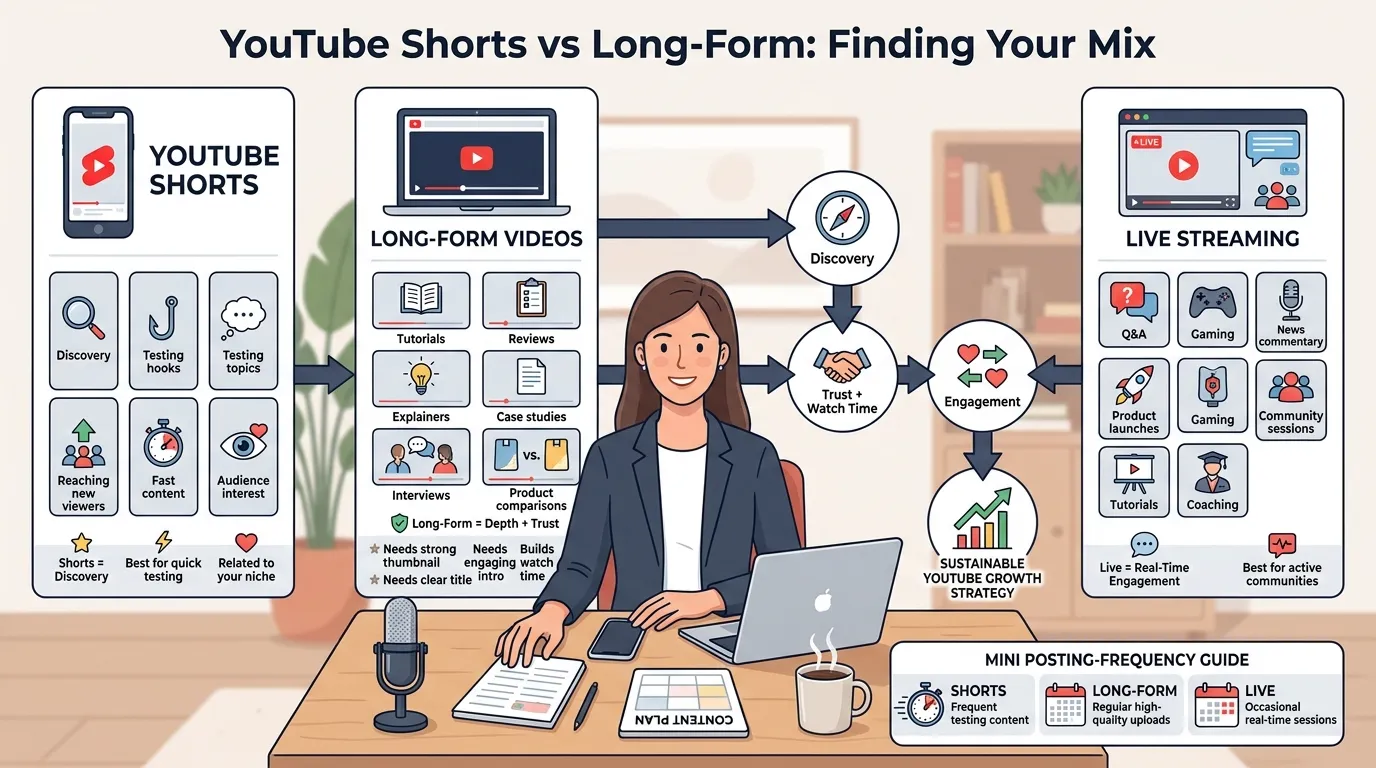
The purpose of the YouTube Shorts and long-form videos are distinct. Shorts create discovery. When it comes to building depth, trust and watch time, long-form videos are suitable.
Long-Form Video Strategy
A good Long-Form Video Strategy provides the viewers with depth. Long form is effective for tutorials, reviews, explainers, case studies, interviews and product comparisons.
Recommended frequency:
- Intermediate: 1 long-form video every 14–21 days.Advanced: 1 long-form video every 21–28 days.
- Establish plants zips: once per week
- The number of channels established: 1 – 3 weekly.
- Brands: 2–4 per month
For longer form videos you will need a compelling YouTube Thumbnail, an engaging title, a good introduction, and structure the video to be engaging.
YouTube Shorts Strategy
A potent YouTube Shorts Strategy puts an idea out there to the test in terms of hook, topics, and audiences of interest. Shorts are practical for uncoverment, yet Shorts ought to be related to your specialty.
Recommended frequency:
- Intermediate: 4 Shorts per week with extra time for memorization and further development
- 5–10% of channels will be growing up to 3 channels a week after 10 weeks.
- Shorts 1-3 per day: FAST NICHES
- Brands: 2-5 pairs of shorts every week
To collect ad revenues from Shorts monetizers must enable the Shorts Monetization Module.
Live Streaming Strategy
The Live Streaming Strategy is most effective when there’s a channel that benefits from there being a real-time engagement, like if the subject matter is applicable in your case.
Do live streaming for:
- Q&A
- Gaming
- News commentary
- Product launches
- Community sessions
- Tutorials
- Coaching
- Behind-the-scenes updates
Recommended frequency:
Beginners: 1 LiveStream per month of Livestreams:
No livestreams per week; 1 livestream once every 2 weeks
- Gambling/#[News] channels: 1-3 livestreams per week
- Situations where the bands will be allowed to live stream: 1 livestream/month or per campaign.
RTMPS encrypts data from the creator to the servers of YouTube, and is suggested by YouTube to be used for YouTube Live.
Recommended Frequencies for Each Format
| Feeding Stage | Starter Food | Growing Food | Gulambar Dhanuka™ |
|---|---|---|---|
| Once a year | Once every 7-14 days | Once a week (1-2 videos) | Once a week (1-3 videos) |
| YouTube Shorts | 2x/week | 3x/week | 5x/week – 14x/week |
| How often do you livestream? | Don’t livestream 1 per month | 1-2 per month | Weekly or more |
| The number of posts in the community is: | 1 per week | 2-3 per week | 3-5 per week |
The 30-60-90 Day YouTube Posting Plan
A 30 60 90 day plan enables creators to test and experiment with upload frequencies, without having to take an educated guess.
Days 1-30: Foundation Phase
The Foundation Stage helps develop your rhythm with the basics.
Tasks:
- Pick one niche.
- Publish 4 long-form videos.
- Publish 8–12 Shorts.
- Test 2 thumbnail styles.
- Test 2 title formats.
- Use key words to write descriptions.
- Create playlists and End screens.
- Check YouTube Analytics on a weekly basis.
Goal:
Identify topics that get “clics” and “clics and sticks”.
Days 31-60: Scaling Phase
The Scaling Phase can only scale the volume up when the quality is also not sliding.
Tasks:
- Be posting at least 1-2 longer (long) form videos weekly.
- Post 3-5 Shorts weekly!
- Batch scripts.
- Batch thumbnails.
- Develop an editing template; make multiple copies of it.
- Use Facebook, TikTok and a Facebook Business Page to promote.
- Test cross-platform teasers.
Goal:
Get more views, but not decrease average watch time.
Days 61-90: Optimization Phase
Optimization Phase makes something that is working better.
Tasks:
- Represent the most successful video formats.
- Improve weak thumbnails.
- Shorten slow intros.
- Make play-sets based on winning topics.
- Test upload times.
- To create a content calendar.
- If burnout is showing, then start decreasing frequency.
- Use the tools to take Long Videos and turn them into Shorts.
Goal:
Discover what’s working best for you in your content over the next 90 days.
YouTube Upload Timing Optimization
YouTube Upload Timing Optimization translates to the ability to upload your video at optimal times in which your target audience is most likely to view. While topic and quality are more important than the time it will be uploaded, timing can assist the first people who will view the upload.
Finding Your Best Upload Times
Review your YouTube viewers to find when folks are viewing by using YouTube analytics. Upload and test 2-3 upload windows for 30 days.
Good test windows:
- Weekday evening
- Weekend morning
- Lunch break
- After school hours
- Before work hours
Do not change the upload time every time so that it is random. Test a variable one after another.
Geographic Optimization for Global Audiences
When consumers are in different countries, Geographic Optimization for Global Audiences is helpful!
Example:
- For people in USA: test between 5 to 8 pm Eastern time zone.
- UK Audience: test: 6 – 8 PM UK time.
- As on India or Pakistan audience, test is conducted at 7-10 PM, local time.
- Global Audience: try out uploads on weekends and Shorts during different times.
Before picking a worldwide timetable, utilize YouTube Analytics geography information.
Content Batching Systems for Consistent YouTube Uploads
Content Batching Systems can assist creators to schedule and publish regularly, avoiding the hassle of rushing with every post.
The 4-Day Production Cycle
The 4-Day Production Cycle can be for weekly videos.
- Day 2: Writing in groups (if necessary)
- Day 2: Record
- Day 3: Edit
- Day 4: Thumbnail, Title, upload, description & schedule.
Describe, record and edit two videos per week in batch two.
Essential Templates for Scaling
The very basics out there required designs in the Scaling template contain:
- Video outline template
- Hook template
- Thumbnail brief
- Title bank
- Description template
- Shorts repurposing template
- Community post template
- Livestream run sheet
- Upload checklist
- Analytics review sheet
Using vidIQ, Social Champ, Ventress.app, Mixcord App Family Company apps, and YouTube Analytics can aid in research and planning, editing and publishing, and reviewing. While tools support the workflow, Tools aren’t a substitute for a good topic and value added content.
Common YouTube Posting Mistakes to Avoid
The common mistakes in YouTube postings occur when content creators are more concerned about how many videos they can upload and pay heed to the viewers.
Critical Errors That Hurt Growth
Some of the critical ERRORS THAT HURT GROWTH are:
- Daily posting using low-quality posts
- Ignoring thumbnails
- Copying competitors exactly
- Built website and upload content that exceeds niche too frequently
- Making slow intros
- Skipping YouTube Analytics
- Deleting videos too quickly
- The re-upload of each sub par-performing videos
- Uploading Shorts that are geared towards the wrong viewers
- When the video doesn’t live up to the content of the clickbait
Warning Signs to Reduce Frequency
Cut back on uploads after experiencing these Signs:
- There is a decrease in the number of people who watched several videos.
- View duration drops, on average.
- Click-through rate declines.
- Comments mention repetition.
- Editing quality falls.
- Can’t get to sleep or on time.
- You end up not researching adequately.
- You rush them to create your thumbnails.
- You are starting to feel creator burnout cycles set in.
Risks of Overloading Your Audience
You could actually overwhelm your audience because they’re viewing too many similar videos, which will clearly hound their click rate down.
Risks include:
- Lower click-through rate
- Decrease return to viewers ratio
- More unsubscribes
- Viewer fatigue
- Lower comment quality
- Weaker brand perception
Increasing the amount of uploads should generate valuable moments, and not just more “noise” for the sake of it.
Quality vs Quantity Debate
Quality Do Not Have To Be A Chosen Or is Not A True Choice. For a creator to find success, they must have both quantity and quality that is sufficient to retain their viewers and develop their skills to learn.
Is It Better to Post One High-Quality Video or Three Mediocre Ones?
Yes, if the single high-quality video has much higher topic demand, thumbnail quality, audience retention and watch time than the three videos, is it inarguably superior to performing worse? Anything 3 average videos can do to test ideas; repeated weakness in upload can affect viewers’ trust.
Best rule:
The more that you post the better it is as long as it’s a video people want to watch.
How to Discover Your Ideal Posting Cadence
The optimum posting schedule is one that keeps the growth to a maximum without a decrease in quality.
Step 1: Assess Your Production Bandwidth
Write the number of hours of each video.
Example:
- Research: 2 hours
- Script: 3 hours
- Recording: 1 hour
- Editing: 5 hours
- Thumbnail: 1 hour
- Upload/writing and making public: 1 hour
- Showcase: 4 hours + Total: 13 hours.
Assume that you have 10 hours per week, two videos per week will not be realistic unless they are good quality videos; one video every 10–14 days may be more achievable.
Step 2: Analyze Your Niche and Competitors
Check 10 competitors.
Record:
- Upload frequency
- Average views
- Best-performing format
- Video length
- Thumbnail style
- Comment questions
- Shorts usage
- Livestream usage
- Posting gaps
- Topics with high retention % will be the topics in which DNA will be allocated.
Find windows of opportunity with less competition, and niche micro-communities.
Step 3: Experiment with an A/B Testing Framework
Run cadence of tests for 30 days.
Avoid testing all at once. Change 1 frequency, while keeping topic and quality constant.
A/B Testing Framework for Posting Frequency
Apply this A/B Testing Framework:
| 7 Days | 100MB | Files and folders for storage |
|---|---|---|
| Baseline retention, views, CTR – Weeks 1-4 – 1 long-form/2 Shorts per week | ||
| 9th – 12th weeks | 1 long-form + 2 Shorts per week | Watch time, burnout, quality |
| Weeks 9-12 | Long-form + 5 shorts per week | Careful impact in the Long from that week; impact on the 5 Shorts per week |
| There is no room for complacency in line-of-sight of the Exams.There can be no resting on our laurels with line of sight of the Exams. |
Pick the schedule with which will benefit the general time watched without the harming of retention.
Using AI to Scale Production and Post More Often
With Artificial Intelligence (AI) writers can post more frequently but not at the expense of original ideas, examples or quality pressure.
Breaking Through Production Bottlenecks with AI
AI can help with:
- Topic research
- Outline drafting
- Title ideas
- Thumbnail concepts
- Description drafts
- Shorts captions
- Editing checklists
- Repurposing scripts
- Translation drafts
Human review matters. AI may miss the mark, end up bouncing back the same tips, or craft generic scripts.
Building a Scalable Content Workflow
This is one way a scalable content workflow can be implemented:
- Apply Artificial Intelligence technology to group topics together.
- Identify/Select themes from YouTube Analytics and comments.
- Write person outline.
- Record, giving personal examples.
- Convert the video to Shorts ideas using AI!
- Edit using a template.
- Upload AND check the list!
- Re-check after 48-72 hours!
Planning with the help of Ventress.app Core Features, vidIQ tools, Social Champ scheduling and editing tools, while the responsibility of protecting voice, accuracy and originality lies with the creator.
How Brands Can Stay Active on YouTube Without Posting More Videos
Brands don’t need to have to be posting full lengths videos each and each day so as to be “active. Brands will be able to utilize Shorts, Community posts, playlists, comments, and livestreams.
Shorts Are a Core Discovery Tool
Shorts can be helpful when it comes to testing hooks, and accessing new audiences. Use Shorts for:
- Product tips
- Behind-the-scenes clips
- Customer questions
- Quick tutorials
- Event teasers
- Announcement clips
- Long-form previews
Avoid posting random/pointless ‘Shorts’ that can draw individuals who will never buy or view longer videos.
Community Posts Strengthen Brand Connection
Community posts assist brands stay seen in between postings.
For this use Community posts:
- Polls
- Product questions
- Behind-the-scenes photos
- Upload reminders
- Link shares
- Customer wins
- Teasers
- Feedback requests
Community posts will be helpful when a brand shares 1-2 longer form videos every month.
What Actually Drives YouTube Growth for Brands
There are four elements to YouTube Growth for brands: usefulness, retention, authority, and discoverability.
Creating Genuinely Useful or Engaging Content for Your Audience
Film products for the brand based on questions from the audience.
Examples:
- Instructions on how to use the product
- What product to target to which customers
- Mistakes to avoid
- Case studies
- Customer results
- Installation guides
- Comparison videos
- FAQ videos
Maximising Audience Retention and Watch Time
To keep more Audience Retention and watch time, you must get rid of parts an Audience doesn’t need and speed up the parts that it does.
Improve retention by:
- Solving backwards from the answer
- Cutting long intros
- Showing examples
- Using clear chapters
- Keeping pacing steady
- Giving the presentation which the title indicated
Building Recognisable Brand Narratives and Authority
Repeatability of the point of view in the brand narrative helps to create trust.
Example:
A software company can establish a reputation for its products by implementing the time-saving functions for small teams. All of the videos can convey that message via tutorials, case studies and workflow tips.
Structuring Content for Long-Term Discoverability
Discoverability is the life-long result of Topics that are Evergreen.
Examples:
- How to use X
- X vs Y
- Best X = Top X for rookies!
- How to fix X
- X setup guide
- X pricing explained
- X mistakes to avoid
After the upload day, you can continue to attract visitors to your videos “evergreen”.
How to Stay Consistent: Strategies for Maintaining a Regular Posting Schedule
It takes a system, not just motivation, for consistency!
Analyzing Your Posting Schedule
Check schedule for every 30 days.
Ask:
- Did I have my work published on time?
- Was there any change in QUALITY?
- What is the video that took TOO LONG to finish?
- What are the reasons for the delays?
- Did viewers respond?
- Has Shorts boosted the performance of longer-length videos?
- Was there any burn-out there?
Practical Strategies for Maintaining Consistency
Use these strategies:
- Batch record videos.
- Save ideas about topics on a daily basis.
- Use templates.
- Keep a title bank.
- Make pre-production plans as Thumbnails.
- Use long videos to make Shorts.
- Have one backup video to use.
- Schedule uploads early.
- Review analytics weekly.
Tips to Stick to a YouTube Posting Schedule
Use an un-complicated weekly system:
- Monday: research
- Tuesday: script
- Wednesday: record
- Thursday: edit
- On Friday we will have thumbnail & upload.Thumbnail & upload will be on Friday.
- Saturday: publish
- Sunday: review comments
There needs to be a weekly repetition and structuring of the rhythm rather than random bursts.
Taking Breaks Without Killing Your Channel
Breaks do not affect the channel’s life. We recognize that when games sit to one day there can be a slowdown in activity, but it’s not a bad thing if it’s one day of uploads.
Before a break:
- Schedule 1–2 videos.
- Make a Community update.
- To remade aged videos as Shorts.
- Pin a playlist.
- Let the viewers know when you’re coming back.
- Prevent Fill videos of Cheesy quality.
Common Pitfalls in Video Upload Scheduling
When uploading files, it’s often a panicky decision.
Does Deleting and Re-Uploading Old Videos Hurt My Channel?
Existing performance signs, comments, watch time as well as viewer history will be erased when old videos are deleted and re-uploaded. Don’t delete and re-upload due to a slow start on videos.
Better options:
- Improve the thumbnail.
- Improve the title.
- Add chapters.
- Update the description.
- Use the Pin a better comment button to attach better comments.
- You can link to the video (from a newer upload).
Get rid of videos just in case they are incorrect, damaging, antiquated or non-brand.
Will the YouTube Algorithm Penalize Me for Missing a Scheduled Post?
The Algorithm doesn’t punish the creator for not having their scheduled post, there’s no mention of this in the public YouTube rules. Not so much the risk of big money but the risk that viewers will expect. Viewers ought not to anticipate an on a regular basis broadcast from a channel, and then see it go out of existence for a few months afterward.
The Final Checklist
Your ideal YouTube posting frequency is the most often you can post without compromising on the quality, thumbnails, retention or viewers’ trust. This is 1 long-form video a week and 2–5 Shorts a week for the majority of creators.
Here are a few guidelines:
- If you’re more of a grown channel, post once a week.
- Posting can be once a week or every two if you do more work on the videos.
- If your niche is one that is easily and quickly produced, post 2-3 times a week.
- If niche speed and niche quality are good, then only post once a day.
- Only post once per month and do so only when each video is deep, searchable and useful.