Key Takeaways

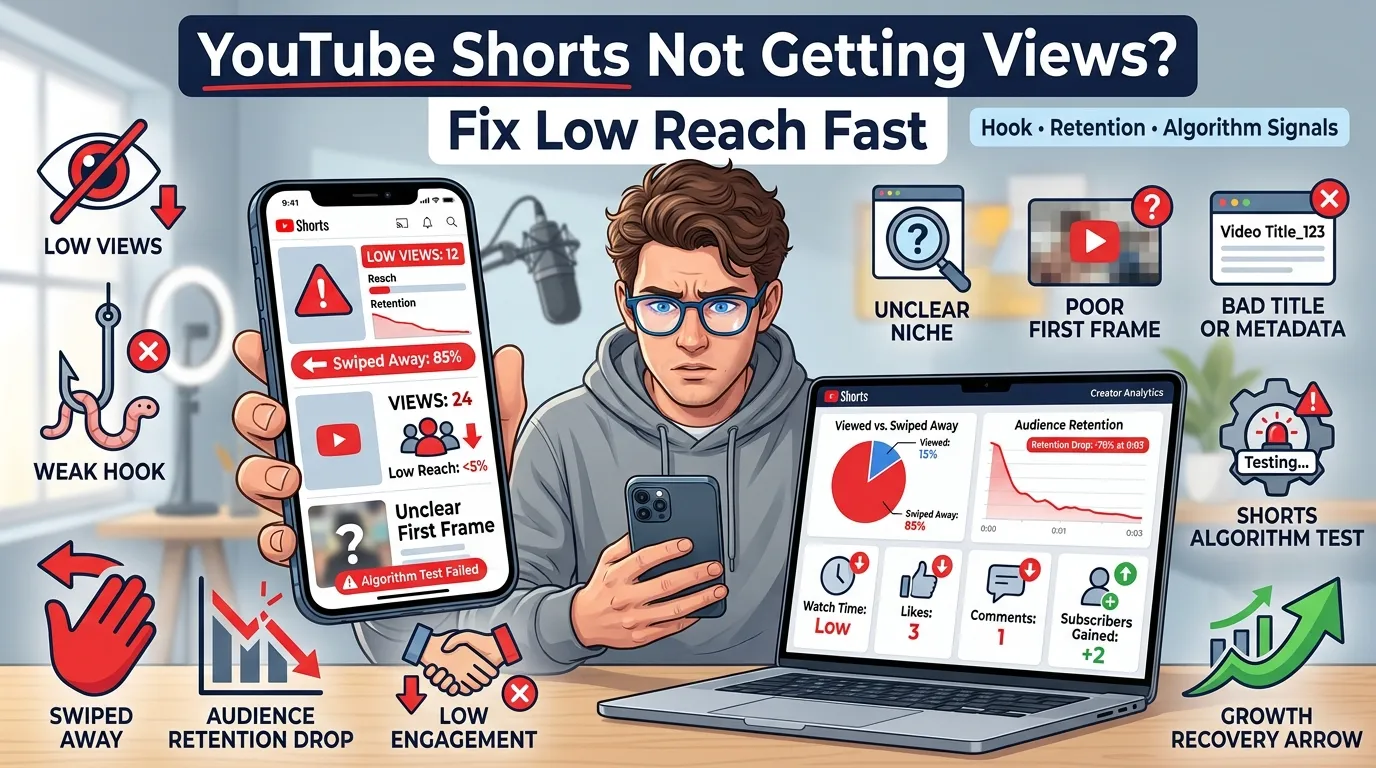
  • Most Shorts that stall have the same few problems: a slow first two seconds, low “viewed vs swiped away”, poor retention or an unclear topic.
  • YouTube tests each Short with a small group first. If they swipe away, it stops pushing it.
  • Check “Viewed vs swiped away” and average percentage viewed in YouTube Studio before changing anything else.
  • Fix the hook first, then the length, then the topic.

Intro

You post a Short, it gets a few hundred views, and then it stops. If that keeps happening, the cause is usually not a shadowban or bad luck. YouTube shows each new Short to a small test audience, watches how they respond, and only then decides whether to show it to more people. When viewers swipe away quickly or stop watching halfway, the Short stalls.

This guide walks through the most common reasons Shorts stop getting views, how to spot each one in YouTube Studio, and what to change in your next upload.

Why Your YouTube Shorts Are Not Getting Views
How the YouTube Algorithm Treats Shorts and Long-Form Differently

The Shorts Algorithm

Shorts View Diagnosis

Why Are Your YouTube Shorts Not Getting Views?

If your Shorts are stuck at low views, the problem is usually not one thing. Check hook, retention, niche match, metadata, posting quality, and viewer response.

Problem 1

Weak First 2 Seconds

If viewers do not understand the video instantly, they swipe before YouTube gets a strong signal.

Fix: Start with the result, mistake, question, or visual payoff immediately.
Problem 2

Low Viewed vs Swiped Rate

Your Short may be shown to viewers, but if too many swipe away, reach can stop quickly.

Fix: Make the first frame clear, bold, and easy to understand without sound.
Problem 3

Poor Retention

If viewers leave halfway, the Short may not earn enough watch time to keep spreading.

Fix: Use one idea, faster pacing, readable captions, and remove filler.
Problem 4

Unclear Niche

Random topics confuse viewers and make it harder for YouTube to know who should see your Shorts.

Fix: Keep Shorts connected to one clear audience, topic, and channel promise.
Problem 5

Weak Engagement

If viewers do not like, comment, share, save, or subscribe, the Short may lack a strong reason to expand.

Fix: Ask one simple question or give one clear reason to comment.
Problem 6

No Follow-Up System

One Short is not enough data. You need repeated tests to find what your audience actually watches.

Fix: Test 20–30 Shorts before changing your full content strategy.
Quick Rule: Low Shorts views usually mean the video failed one of these signals: hook, swipe rate, retention, relevance, or engagement.

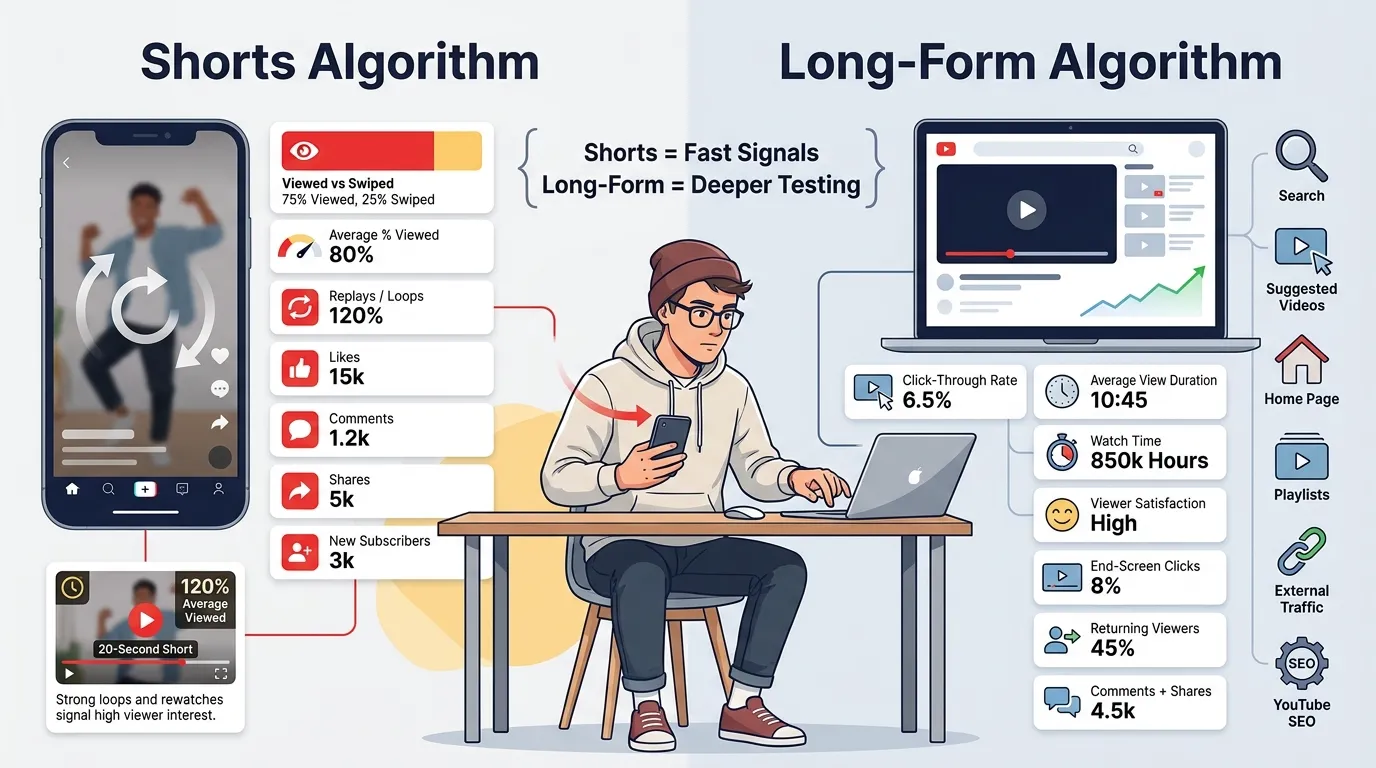
The algorithm called “Shorts” provides focus to quick signals. The viewing window for how people watch shorts is shorter; therefore, early viewer behavior is more important.

Important Shorts: Signals include:

  • How many of Donald’s tweets are read vs viewed and discarded?
  • Average percentage viewed
  • Replays and loops
  • Likes
  • Comments
  • Shares
  • New subscribers

Shorts algorithm means it can be rewarding high loops as viewers are likely to view the shorter clips more than once. If it has 120% average viewed, it can be a 20-second Short and indicate to YouTube that the video had focus.

Best Practices for Shorts in 2026

Hook Fix Library

Shorts Hook Examples That Stop the Swipe

The first 1–2 seconds decide whether viewers keep watching or swipe away. Use these hook styles to make your Shorts clearer and stronger.

Hook Type 1

The Mistake Hook

Works well when your audience is doing something wrong and needs a quick correction.

Example: “Your Short is not failing because of hashtags. It is failing because people swipe in the first 2 seconds.”
Hook Type 2

The Result Hook

Start with the outcome viewers want, then explain the fast reason behind it.

Example: “This one change can make more people watch your Short until the end.”
Hook Type 3

The Question Hook

Questions work when they match a real pain point your audience already has.

Example: “Why did this Short get 30 views while another one got 30,000?”
Hook Type 4

The Quick Checklist Hook

Use this when your Short is educational and viewers want a fast, practical answer.

Example: “Before you post your next Short, check these 3 things.”
Best Practice: Do not start with “Hey guys,” a logo, or a long setup. Give the viewer a reason to stay immediately.

Fast, clear, and remembered; that’s the building block of best practices for a new year, 2026.

Use these 10 rules:

  1. Capture viewers’ attention within the first 1-2 seconds of viewing.
  2. Try to only have one idea to a Short.
  3. Use captions.
  4. Remove slow intros.
  5. Use clear visuals.
  6. Create loops.
  7. Try 3 variations of an idea.
  8. Use niche trends.
  9. Add a simple CTA.
  10. Analysis of retention and an increase in subscribers.

In June 2026, YouTube shared some updates which include some changes to the Shorts player, Clear Screen mode, playback speed changes, and more.

Common Challenges and How to Overcome Them

Shorts Mistake Fix Library

Common Reasons YouTube Shorts Stop Getting Views

Most low-view Shorts have a fixable problem. Improve one issue at a time instead of changing your entire strategy after one weak upload.

Mistake 1

Posting Random Shorts

Random viral topics may get impressions, but they can confuse your audience and weaken your channel promise.

Fix: Keep Shorts connected to your niche, long-form videos, and target audience.
Mistake 2

Making Every Short Too Long

A 15-second idea stretched into 60 seconds can destroy retention and reduce repeat viewing.

Fix: Match the length to the idea: quick tip, mini tutorial, story, or product demo.
Mistake 3

Using Weak Captions

Many viewers watch with sound low or off. If captions are hard to read, people may swipe away.

Fix: Use clear captions, strong contrast, short lines, and no tiny text.
Mistake 4

Expecting One Short to Prove Everything

One low-view upload does not mean your niche, channel, or format is wrong.

Fix: Test batches of Shorts, compare patterns, and improve based on repeated data.
Quick Rule: Do not blame the algorithm first. Check hook, niche fit, retention, captions, and viewer response before changing direction.

There are 5 common questions creators ask when determining between Shorts and Long-Form.

  • Low Shorts subscribers: include a more concrete niche promise.
  • Low Improve titles and thumbnails for longer-form videos.
  • Low shorts retention: make the hook shorter.
  • Low Watch time in LF: trim LFs.
  • Low revenues: create ads on affiliate offers, sponsorships, products, and email captures.

Don’t blame the format first; package, retention, and audience match second.

Why Early Likes Matter More on YouTube Shorts Than Long-Form Videos

Shorts Analytics Fixer

Which Shorts Metric Explains Your Low Views?

Views alone do not explain performance. Use these metrics to understand whether your Short has a hook problem, retention problem, engagement problem, or niche problem.

Metric 1

Viewed vs Swiped Away

If this is weak, people are rejecting the Short before it has a chance to perform.

Fix: Improve the first frame, shorten the hook, and make the topic obvious immediately.
Metric 2

Average Percentage Viewed

If people start watching but do not finish, the Short may be too slow or too long for the idea.

Fix: Cut dead space, keep one idea, and test a shorter version.
Metric 3

Likes, Comments, Shares

If engagement is low, the Short may not be useful, emotional, surprising, or clear enough.

Fix: Ask one direct question or give a tip viewers want to save or share.
Metric 4

Subscribers Gained

If views come but subscribers do not, the content may not match a clear channel promise.

Fix: Align the Short with your niche, playlist, and long-form content path.
Simple Rule: If views are low, check swipe rate first. If views are high but growth is weak, check subscribers gained and long-form clicks.

Likes on YouTube Shorts are more significant in the early days, as it is a shorter period of time where people can view and engage with the content. The Shorts Algorithm is looking for fast signals.

Shorts Live or Die in a Faster Viewing Window

A short will make or break itself quickly for it will be swiped at quickly. If the first two are weak, the test can terminate not allowing the video to be seen by more viewers.

A Short needs:

  • Fast hook
  • Clear subject
  • Strong visual
  • Quick payoff
  • Simple CTA

Early Likes Help Confirm That the Right Viewers Care

Likes early in the day are more likely to validate that the proper kind of viewers care. Likes are not the only signals, but likes help retention, comments, shares and replays.

In general, creators can boost likes early in the video by presenting one piece of actionable advice or asking a concise question in their video prior to the CTA.

Why Long-Form Videos Have More Room to Breathe

Long-Form videos have more room to breathe,athe as your videos can be tested on Search, Browser, and Suggest videos, playlists and other external traffic.

A Long-Form video does not need to bequick, to recover from the slow start with search traffic. A Short is a shorter recovery time.

The Smarter CTA Is Built Before Publishing

The smarter CTA is designed up front before publication. You should be aware of what you want people to do after watching each video.

In the case of “Shorts,” use one CTA.

To use a CTA path in Long-Form.

An instance of a Long Form CTA path is shown below:

  • Subscribe
  • Let’s not forget to see the video.
  • Download a resource
  • Join an email list
  • Test a product/service

Summary

Shorts usually stop getting views because the test audience swipes away or stops watching early. Look at “Viewed vs swiped away” and average percentage viewed for each Short, fix the opening two seconds first, keep Shorts tight and focused on one idea, and post consistently within a clear niche. Small improvements to the hook often make the biggest difference.


Rushi Patel

About the Author

Rushi Patel

Rushi Patel is a social media writer and digital content creator with more than five years of experience across Instagram, TikTok, YouTube and Facebook. He founded Fast Video Save to provide clear, practical and beginner-friendly information for creators, marketers, small businesses and everyday social media users. Rushi researches platform features, creator tools, content strategies, algorithm changes and monetization methods. His goal is to simplify complex social media topics while encouraging responsible use and respect for platform policies. His main areas of focus include Instagram Reels, YouTube and Shorts, TikTok content, Facebook marketing, creator growth and social media monetization.