
Scroll through your Instagram feed right now. What stops you? Probably not a perfectly lit, color-graded, music-synced Reel with a professionally designed title card. Chances are it’s something messier — someone talking directly to camera, mid-thought, in a moving car, with the kind of energy that makes you think: wait, what did they just say?
That’s not an accident. That’s the algorithm at work — and more importantly, that’s human psychology doing exactly what it was always going to do.
Table of Contents
ToggleWhy Raw Is Dominating Right Now?
There’s a fatigue happening across every social platform. Audiences have been trained to recognize “content” — and the moment something feels like it was made to go viral, it dies. The polish itself has become a cue to scroll past.
Raw content, by contrast, triggers something different: credibility. When someone films themselves in imperfect lighting, stumbles over a word, or skips the intro music — it reads as real. And real is what earns attention in an environment drowning in manufactured authenticity.
Instagram’s algorithm has also shifted decisively. Reach is now heavily weighted toward watch time, replays, and shares — not follower count. A 90-second raw Reel that people watch twice beats a 15-second cinematic cut that gets swiped in 2 seconds every time.
The 3-Second Rule Is Non-Negotiable
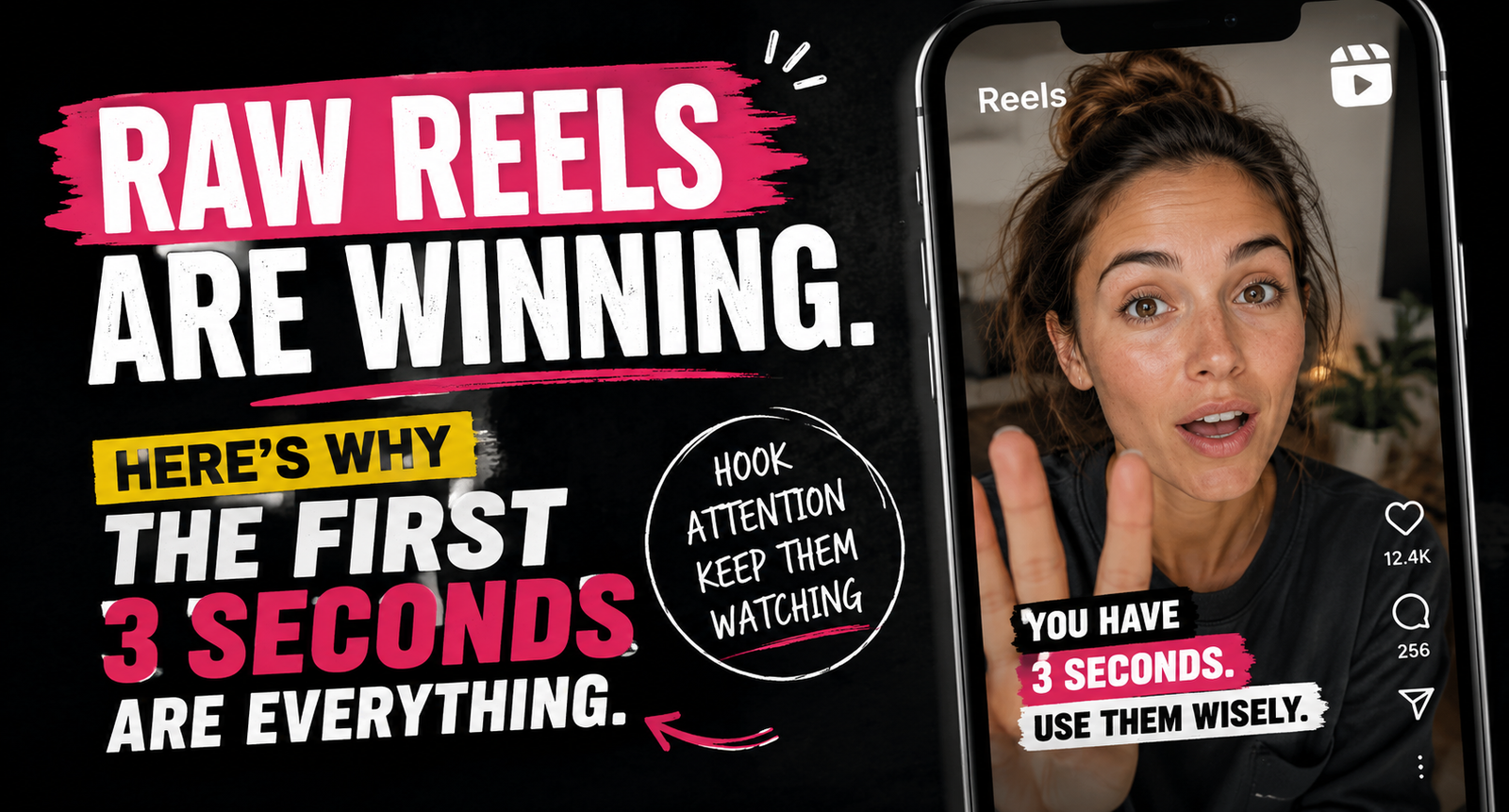
Three seconds. That’s your entire audition. Not for the algorithm — for the human watching. The algorithm just measures whether you passed or failed.
In that window, a viewer’s brain makes a binary decision: this is for me or this isn’t. Production quality barely factors in. What matters is pattern interruption — did something in those first frames break the scroll rhythm and create a question in the viewer’s mind that they need answered?
What makes a 3-second hook land
- Start mid-sentence or mid-action. Don’t introduce yourself. Don’t say “so today I wanted to talk about…” Drop the viewer into something already in motion.
- Lead with the payoff, not the setup. Tell them the most interesting thing first, then explain how you got there. Journalism calls this the inverted pyramid. Reels calls it not getting ignored.
- Use tension or contradiction. “Everyone says X — but here’s what’s actually happening” is more effective than any transition effect ever will be.
- Make eye contact from frame one. Looking directly into the lens in the first moment creates an instinctive social response — the brain registers a face making eye contact and pauses.
- Let captions do double duty. Many people watch on mute. Your first caption line should be punchy enough to stop a silent scroller on its own.
Raw Doesn't Mean Careless
Here’s where most creators misread the moment. Raw doesn’t mean low-effort. It means strategically unpolished. There’s a difference between a video that looks rough because it’s authentic, and a video that looks rough because nothing was thought through.
The best raw Reels are actually tightly engineered underneath. The creator has a clear point. They know their hook. They’ve thought about where to place the most interesting moment. They’ve just stripped away everything else the intro, the outro, the lower thirds, the B-roll — because none of it was earning attention.
What to Actually Change in Your Reels
If your current approach leans heavy on production, you don’t need to throw it all out. You need to renegotiate where your effort goes.
→ Spend 80% of your prep time on the first three seconds and the core point. Let everything else be loose.
→ Cut your intro completely. If you have a 5-second intro sequence of any kind — music sting, logo, name card — remove it. That’s not branding, that’s the scroll trigger.
→ Film more takes with less editing. Rather than one take with heavy cuts, try 3–4 versions and keep the one where your energy is highest — even if there’s a stumble.
→ Watch your own Reel on mute before posting. If the caption and the first frame don’t tell you something interesting, reshoot.
→ Test B-roll-free versions. If you normally cut to B-roll after 5 seconds, try a version where it’s just you, talking, the whole way through. You may be surprised.
The Bigger Shift This Points To
If your current approach leans heavy on production, you don’t need to throw it all out. You need to renegotiate where your effort goes.
→ Spend 80% of your prep time on the first three seconds and the core point. Let everything else be loose.
→ Cut your intro completely. If you have a 5-second intro sequence of any kind — music sting, logo, name card — remove it. That’s not branding, that’s the scroll trigger.
→ Film more takes with less editing. Rather than one take with heavy cuts, try 3–4 versions and keep the one where your energy is highest — even if there’s a stumble.
→ Watch your own Reel on mute before posting. If the caption and the first frame don’t tell you something interesting, reshoot.
→ Test B-roll-free versions. If you normally cut to B-roll after 5 seconds, try a version where it’s just you, talking, the whole way through. You may be surprised.