
Key Takeaways
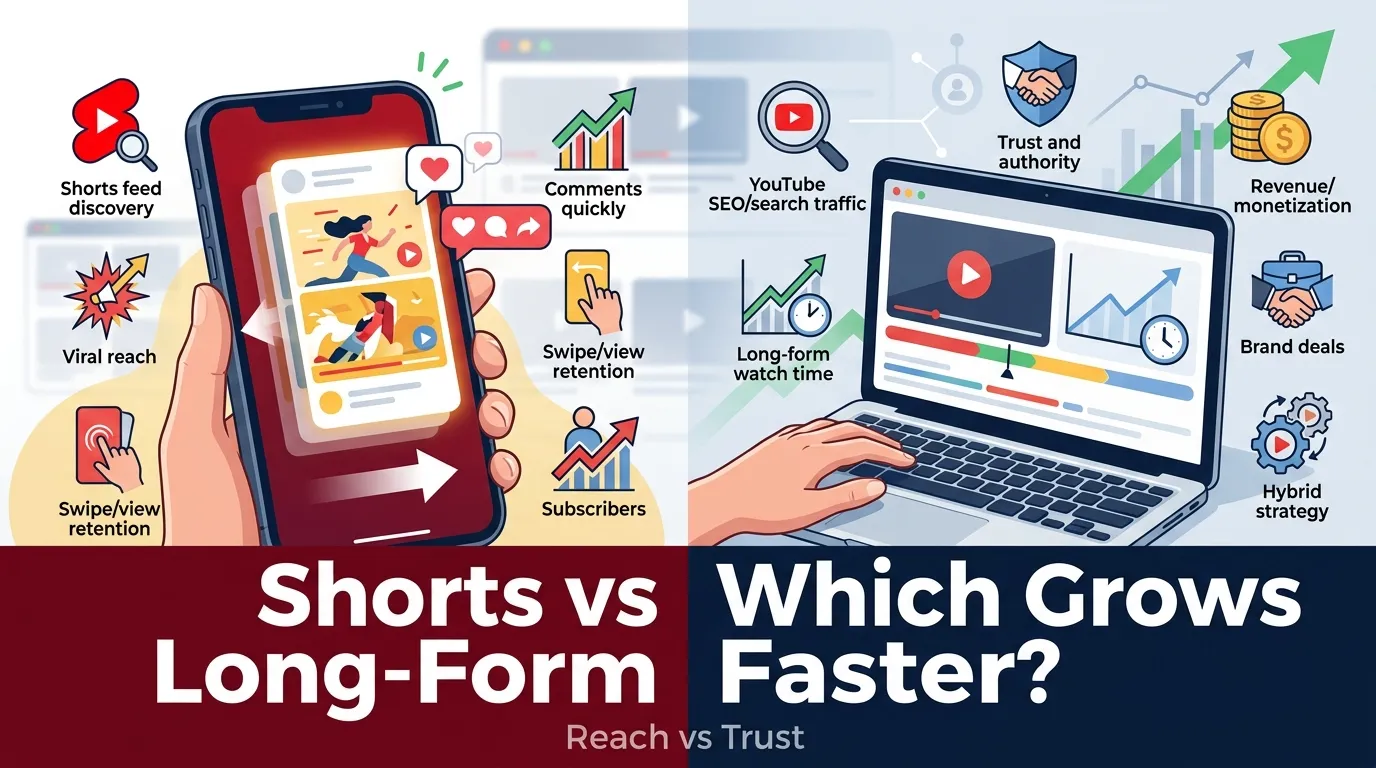
- More precisely, Shorts can reach new viewers rapidly via the Shorts feed, in this way contributing to the quicker expansion of channel recognition on YouTube.
- For better audience trust, opt for longer videos on YouTube, as the viewer is “hanging out” with the creator for more extended periods.
- For many creators, the Shorts monetization potential may not be as high as that of regular videos, as Shorts revenue also comes from ads placed on Shorts’ feed and is calculated differently from normal videos. The Shorts ad revenue sharing is available when creators accept the Shorts Monetization Module and Shorts Revenue Per Mille (RPM) is the metric based on 1,000 engaged views, YouTube said.
- Standard videos allow for longer watch times, mid-roll ads on eligible videos, sponsorships, products, podcasts and deeper brand integration, making for a stronger Long-Form monetization.
- Whether choice of formats is good or bad depends on the target: In case of growth, Shorts are better for reach, while Long-Form are better for making money and both for a stronger channel.
Intro
Long-form videos tend to generate more trust, watch time and revenue, while YouTube Shorts tend to gain more reach and subscribers. Shorts or Long-Form does not account for the best answer in 2026. A combination approach is often more effective as Shorts can help to increase channel discovery and Long-Form can help to increase trust.
YouTube Shorts vs Long-Form Video is the comparative growth of short vertical videos and longer videos on YouTube in general. Shorts are designed for instant viewing, instant testing, high looping and rapid audience growth. Long-Form Videos are designed to be deep, for more search traffic, watch time, monetization, authority, and leaner community ties.
Understanding the YouTube Shorts vs Long-Form Landscape in 2026
The success of YouTube Shorts compared to Long-Form Video in 2026 will ultimately rely on factors like audience behavior, content niches, and monetization strategies. When the creator must reach it quickly, shorts are the best option. Long-Form is ideal for the creator who is looking for authority, sales, watch times, and better quality brand deals.
YouTube has expanded the length of Shorts to 3 minutes, and the YouTube’s own Shorts guidelines state that “Shorts are limited to 3 minutes, and should be attention-grabbing in the first seconds.”
There are 3 distinct forms in the landscape:
- Shorts motivate initial subscribers.
- Long-Form lowers your rate of churn.
- It is the hybrid approach that is the most effective for content producers looking for both growth and money.
Shorts can be used to experiment with trends, while Long-Form can be used to explain workflows, such as a channel on AI Editing, the YouTube Shorts Maker tools, Smart Auto-Reframe, Animated Captions, Auto Subtitles, Bulk Edit and Autopilot Publishing.
How the YouTube Algorithm Treats Shorts and Long-Form Differently
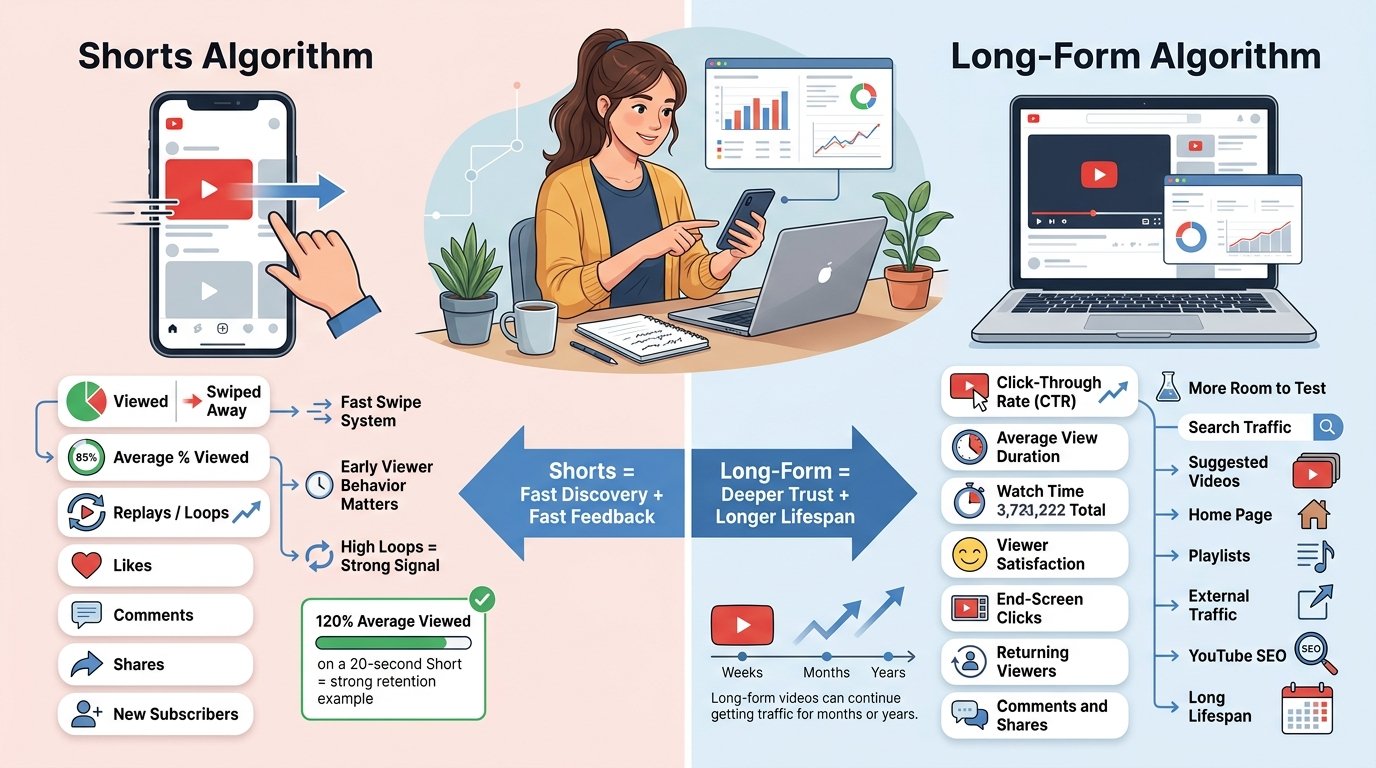
Just as the YouTube Algorithm handles Long-Form and Shorts differently, it is important to note that viewers behave differently to each of these formats. Shorts are judged as it pertains to the fast swipe system. Click, watch time, satisfaction, and session behavior are the metrics used for judging Long-Form videos.
The Shorts Algorithm
The Shorts Algorithm is bull market time based. Early viewer behaviors can impact the viewing experience of the shorts.
Important Shorts are signified by:
- Viewed – vs. swiped away.
- Average percentage viewed
- Replays and loops
- Likes
- Comments
- Shares
- New subscribers
Shorts algorithm pays for the high loops, viewers are more likely to view short clips multiple times. YouTube can conclude that your video holds the attention of viewers if it has a 120% average viewed for 20 seconds of Short.
The Long-Form Algorithm
In the case of the Long-Form Algorithm, the algorithm has a larger space to test a video. Long-Form videos have the opportunity to go viral via search, suggested videos, home page, playlists, external traffic and YouTube SEO.
Important Long-Form signals are:
- Click-through rate
- Average view duration
- Watch time
- Viewer satisfaction
- End-screen clicks
- Returning viewers
- Comments and shares
Videos can live for months or years due to long form SEO search traffic. People are searching for detailed answers and niche topics do very well in long-form.
The Appeal of YouTube Shorts
YT Shorts are attractive as creators can produce quicker, test more quickly, and attain a larger audience of new viewers. Along with more viral potential, shorts are less expensive to produce.
Quick and Easy to Produce
They are quick to produce due to their short, mobile-first and vertical format. Each idea can be set on a 15-60 second recording by a creator.
AI Editing, Animated Captions, Auto Subtitles, and Smart Auto-Reframe and Bulk Edit, as well as AI Autopilot Publishing, can be supported by tools like Miraflow AI, WayinVideo, YTNinja, and YouTube Shorts Maker software.
Potential for Viral Success
The feed provides a lot of small tests to new videos, meaning that five-minute shorts have great potential of going viral. A Short can be viewed by people who never before saw the channel.
If the hook is obvious in the first 1-2 seconds, then the short version will be the effective one to reach a growing audience quickly.
High Engagement Rates
With the short viewing time, viewers are likely to be engaged by liking, commenting or re-sharing videos.
Retention of a SHORT with a strong loop could be high. A Short of clear question can gain comments.
Easy to Repurpose Across Platforms
With easy repurposing options like Instagram Reels, TikTok, Facebook Reels, Pinterest Idea Pins, and LinkedIn short video, you can get creative.
Content repurposing strategy is a time-saving plan. One one Long-Form video can be made into 5-10 Shorts.
Complement Long-Form Content
However, Shorts is an addition to the Long-Form content format, with each short directing viewers to the longer video. Shorts can serve as a teaser of a tutorial, review, podcast, and/or case study for a creator.
For instance, a creator might make a Short titled “3 mistakes killing your YouTube retention” and direct users to a 12-minute longer video.
Attractive to Brands
Brands love shorts for their ability to give fast call to action and fast campaign testing. A brand can put out a hook, product angle, or offer and until they pay for an upfront bigger integration on the LFM.
This is where brand deals can begin with Shorts, however, bigger brand deals tend to be available from Long-Form with audience trust.
The Downsides of YouTube Shorts
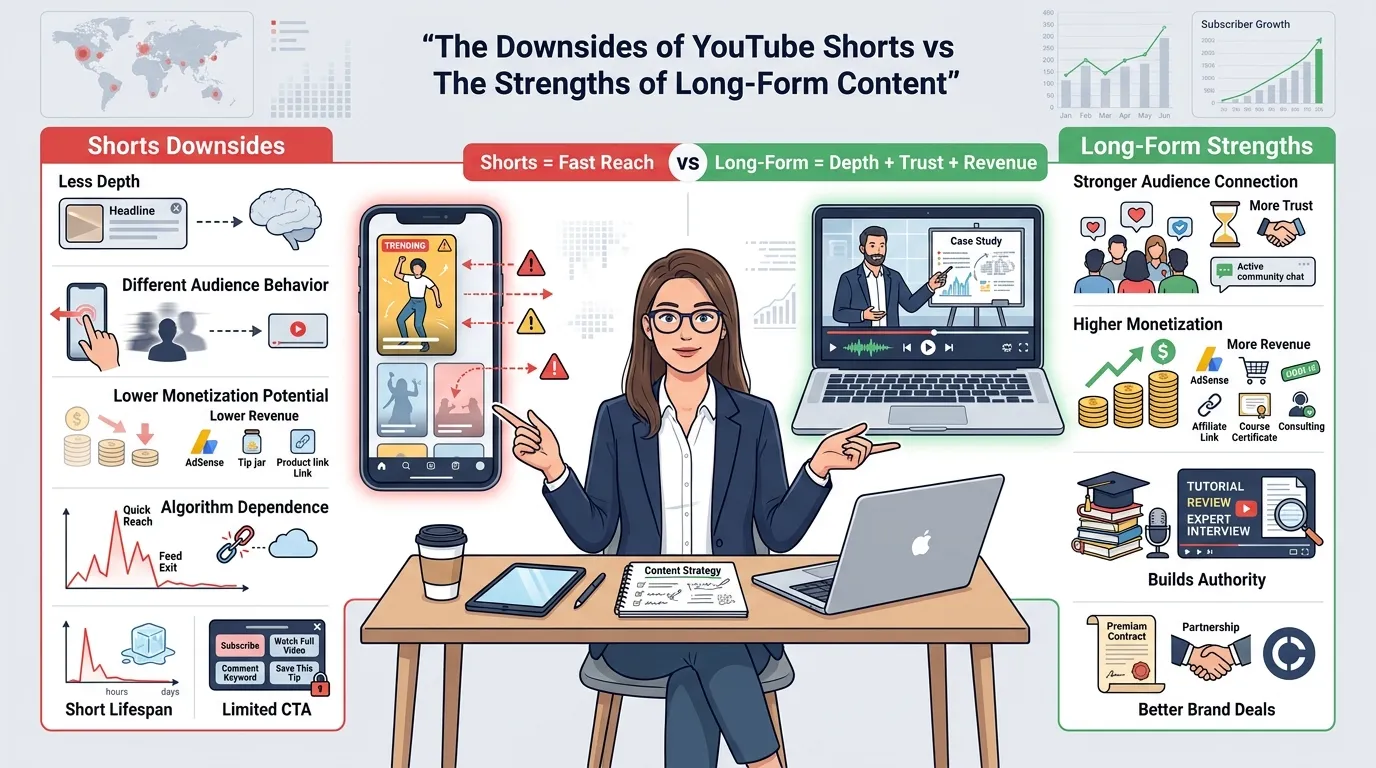
The 6 drawbacks of YouTube Shorts are: shallower content, altered audience behavior, decreased revenue potential, algorithm dependency, brief lifespan, and restricted call to action.
Less Depth
Because of the short format, there’s less depth to the shorts. A Short can be used to start a topic; however, it is not sufficient to explain complex topics.
There are topics that require Long-Form videos or blog content, including WordPress Learning Management System setup, HTTP vs HTTPS, Web Infrastructure, Identity theft prevention, Modern Companies’ Design and Development systems and Generative Engine Optimization.
Different Audience Behavior
Speed watching often involves watching in a hasty manner. There are limits on watching Long-Form videos on Shorts automatically, while there are no such limits for Shorts viewers.
The differences in audience behavior make a difference. High numbers of Short views don’t necessarily produce high numbers of Long-Form views from the same channel.
Lower Monetization Potential
Shorts is also less profitable for many creators as the revenue for Shorts hinges on Shorts feed ads and engaged views. After signing up to the Shorts Monetization Module, according to YouTube information, you will get a share from the income earned by views on Shorts.
Long-Form videos can monetize via typical advertisements, banners, sponsorships, affiliate links, education courses, consulting work, merchandise, and email funnels.
Algorithm Dependence
The Shorts feed is crucial to the Shorts. With a short pullout, the reach can stall out.
Unlike evergreen Long-Form search traffic, Shorts is more unpredictable than ever before, due to the algorithm dependence.
Shorter Lifespan
Shorts tend to have a shorter lifespan than LF videos. A Short can spike super quick and drop super quick.
Even though these aren’t the most important things to consider, shorter life terms can also benefit a channel, provided the creator is conducting a “lifespan of shorts” test for content market fit.
Limited Call to Action
Shorts have a limited number of calls. Viewers “swipe” from one page to the next, and you don’t have a lot of time to describe a product, lead magnet, subsequent step etc.
CTA should be easy to understand:
- Subscribe for more.
- Please view the complete video.
- Comment the keyword.
- Save this tip.
The Strengths of Long-Form Content
There are 4 key strengths of Long-Form content: it makes it monetize better, audiences connect with it more, it builds authority and offers better brand deals.
Higher Monetization
For many channels, the longer the form, the more money in ad revenue they will make, as the watching time increases. Sponsorships, affiliate explanations, product placements, and longer ad campaigns can all be executed by way of longer videos.
If you build 10 million valid public view counts of Shorts within the past 90 days or 1,000 subscribers within 12 months with 4,000 valid public watch hours, you will be selected as a Youtuber for the YouTube Partner Program (YPP). In the case of the “feed”), the total of watch hours spent in the shorts will not be considered public watch hours.
Stronger Audience Connection
Long-Form is better for building the connection of the viewers as they spend more time with the creator. Twelve minutes of a tutorial will give someone more trust than two minutes of a tip.
Long form can help foster a stronger sense of community if the audience sticks around to hear the explanations.
Builds Authority
The person creating has a great authority to develop in Long – Form when they explain a topic clearly. Build expertise through tutorials, reviews, podcasts, interviews, case studies and lessons.
They can create Long-Form videos for a creator teaching Business Event Success on topics such as a Project Managers, Speaker Selection, event planning, and event-sponsor strategy.
Higher-Quality Brand Deals
Long-Form videos tend have more successful brand deals as they are able to put value, features, proof and provide details.
For instance, a Google Ads software sponsor would rather hear about how to set up Google Ads on their website rather than a 20-second mention. More explanation is also required for breeze creator capital, Free Audit, and LLC services, which is something that most Shorts are unable to provide.
The Challenges of Long-Form Content
Producing on a larger scale, too low engagement rates, and slower growth, are the 3 major difficulties of creating Long-Form content.
Higher Production Costs and Time
Long-Form videos require more time in planning, recording, editing, uploading, and optimizing. It can take hours of research and work to put together a 12-minute video.
Production work includes:
- Topic research
- Script writing
- Recording
- Editing
- Thumbnail design
- YouTube SEO
- Description writing
- Chapters
- End screens
Lower Engagement Rates
The reason for this difference in engagement could be that the longer a viewer has to complete a video, the less engagement they will have, as in the case of Long-Form videos.
A viewer can watch an entire Short, and like it rapidly. It takes up to 10 minutes for a viewer to decide if it deserves to be liked, commented on, or subscribed to, for a Long-Form.
Slower Growth
Videos rely on clicks, watch time, search traffic and suggested views traffic, which makes the Long Form growth slower in some instances.
Long form channel growth is a gradual process but Long-Form can build a strong long-term value.
Monetization: Where the Money Actually Is
While Shorts typically aren’t as strong financially, encourages the monetization with the help of building discovery. Shorts can actually draw focus. Long-Form turns heads into dollars.
Monetization for YouTube Shorts
Monetization opportunities for YouTube Shorts include monetary reward from shorts ad revenue sharing, monetization through YouTube Premium, fan funding features, through sponsorships, with affiliate links, through product suggestions and through brand campaigns.
According to YouTube, the YouTube ad revenue-sharing for Shorts is only to eligible views after accepting the YouTube Shorts Monetization Module.
Shorts are suitable for:
- Product awareness
- Low-ticket offers
- Email list growth
- Brand reach campaigns
- Affiliate reminders
Monetization for Long-Form Videos
Monetization for Long-Form videos involves ads, YouTube Premium, sponsorships, affiliate linking, memberships, courses, consulting, services and products.
Detailed offers are possible to promote on Standard Long-Form videos. A creator has the ability to explain a device such as Miraflow AI, WayinVideo, Cheap Proxies, Google Ads, or even a WordPress Learning Management System, with a complete tutorial.
Optimal Video Length for Maximizing Revenue
The length that viewers click through and still has time for value and monetization is the ideal video length for maximum profit.
Use this simple guide:
- 6-8 minutes for basic instructions
- The time to review and explain is from 8 to 15 minutes.
- Deep tutorials, podcasts, case studies: 15 – 30 mins
- Expert interviews and training sessions for 30+ minutes.
Bigger isn’t necessarily better. Retention and Value >Length.
Which Content Types Work for Each Format
Various content formats are more effective for various types of content.
Best for Shorts
The most ideal shorts for:
- Quick tips
- Before-and-after clips
- Mistake lists
- Trend reactions
- Mini tutorials
- Fast product demos
- Clip highlights
- Simple opinions
Trendjacking is good to use when the trend is in the niche, and if it is, shorts for the trend will work well.
Best for Long-Form
The best use for Long-Form is:
- Tutorials
- Reviews
- Case studies
- Podcasts
- Interviews
- Product comparisons
- Strategy breakdowns
- Educational series
Detailed topics require more context, which makes long form great for niche topics.
Creating an Effective Content Mix: Shorts and Long-Form
The wide use of Shorts and Long-Form is an effective combination. Shorts attract. Long-Form converts.
The Hybrid Strategy: Use Shorts as Teasers for Long-Form
The hybrid approach will comprise Shorts as teasers to Long-Form. A creator uploads a Long-Form video and slices portions that are 3-7 minutes long into Shorts.
Example:
Long-Form video subjects include: “YouTube Shorts vs Long-Form Video: Which Grows Faster?
Short 1: “Shorts grow more quickly but there is a catch.”
Episodic #2: “Why Long-Form makes more money.
Short 3: “The optimal content mix in 2026.
Why This Works
There seems to be a good reason why hybrid strategy is working: Each format addresses a different problem.
Shorts solve discovery.
Long-Form solves trust.
Playlists take care of binge watching.
End screens provide solutions for next steps.
Outside of YouTube, email and Blog content handle retention.
How to Use Shorts and Long-Form Together on YouTube
Here are simple 5 steps to follow:
- Create 1 Long-Form video.
- Remove 3 Shorts from the best ideas.
- Provide links to the complete video.
- Add the Long-Form video to a video playlist.
- Check out who has the most subscribers on which Short.
A successful channel combines a variety of strategies and does not try to be a channel of ‘random posts’. There are a sequence of Shorts supporting a bigger channel goal.
Best Practices for Shorts in 2026
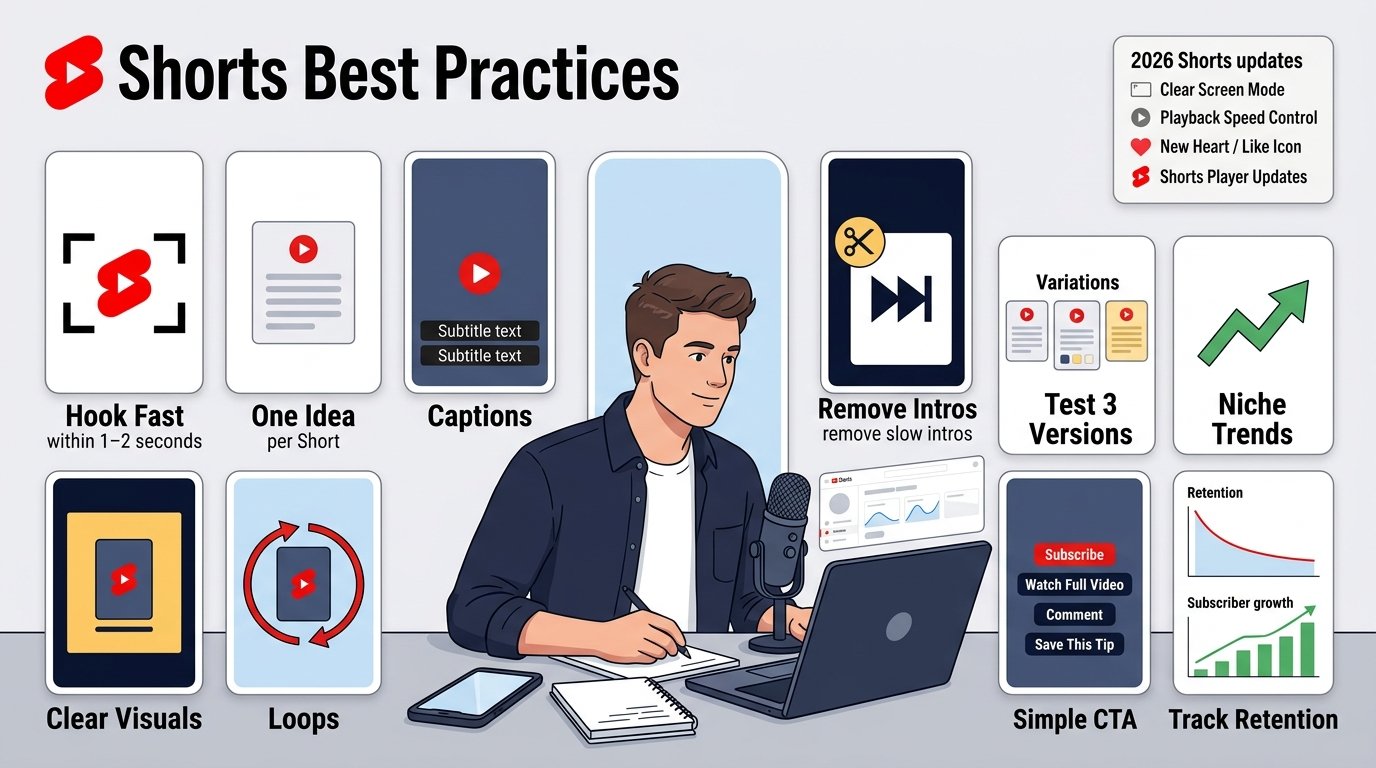
Speed, clarity and retention are the key elements of best practices for Shorts in 2026.
Use these 10 rules:
- Capture the attention of a viewer within the first 1-2 seconds.
- Avoid trying to combine more than one idea per Short.
- Use captions.
- Remove slow intros.
- Use clear visuals.
- Create loops.
- Try out 3 alternatives to an idea.
- Use niche trends.
- Add a simple CTA.
- Monitored retention rate and subscribers’ growth.
In June 2026, YouTube revealed some modifications, such as Clear screen mode, possibility of adjusting playback speeds, a brand new icon of a coronary heart, and extra adjustments to the Shorts player.
Which Format Builds a More Valuable Channel Faster
Channel earned value understood as revenue, trust, authority and loyal viewers is the better way to grow a more valuable channel for Long Form. When value equals reach, impressions and subscriber numbers, the shorts route will be the winner to expand an audience faster.
Make use of this easy response:
- Fast reach: Shorts
- Fast trust: Long-Form
- Fast testing: Shorts
- Fast revenue: Long-Form
- Backbone channel to be deployed: Hybrid strategy
Which Format Is Better for Specific Goals
It depends on the goal which format is better.
- Subscriber growth: Shorts
- Watch time: Long-Form
- Ad revenue: Long-Form
- Brand awareness: Shorts
- Brand trust: Long-Form
- Product sales: Long-Form
- Trend testing: Shorts
- Authority building: Long-Form
- Content repurposing: Hybrid
- Community, long form: community + long form posts
For creator with Google Ads, LLC services, use Long-Form for trust and take advantage of Shorts for reach.
Common Mistakes Creators Make Choosing Between Formats
The Seven Creative Errors When Deciding on Shorts or Long Form:
- publishing Unsupported Shorts.
- Uploading Long-Form with poor thumbnail images.
- Anticipating that the viewers of “Expecting Shorts” will be watching all of the Long-Form videos.
- Ignoring YouTube SEO.
- Using the same CTA in every format.
- Pursuing “viral” trends that aren’t right for the channel.
- Quitting LFF too soon.
The worst thing you can do is make the format your entire approach. “Form equals only part of growth.”
How to Decide Which Format to Start With
Consider starting with Shorts if the creator requires quick testing and time is limited. For a creator who requires trust, search traffic and monetization, begin with Long-Form.
Select the “Shorts” option first for:
- Entertainment
- Quick tips
- Visual topics
- Trend reactions
- Beginner testing
Select the first choice as Long-Form:
- Education
- Tutorials
- Reviews
- Business services
- High-ticket offers
- Authority niches
Pick both when the creator is able to put out nameable product without reducing on quality.
Summary
In general, videos that are longer are more likely to create a “better” channel while YouTube Shorts increase the speed of channel discovery. Shorts create speed. Long-Form creates trust. A hybrid approach provides creators with both.
Leverage Shorts for fast audience expansion, trend testing, repurposing content, high engagement and quick discovery. Go for the Long-Form with authority, watch time, monetization, brand deals and solid audience engagement.
Best YouTube Growth plan – mix content strategy: create Long-Form videos for depth, create Shorts for reach, playlists (Shorts and Long-Form), track content performance in YouTube Analytics, optimize content based on channel objective.
A combined strategy works great thanks to all the Shorts having a specific objective and all the Long-Form videos having an objective for the viewers to stick around for.