Table of Contents
ToggleWhat the Blue Tick Actually Means
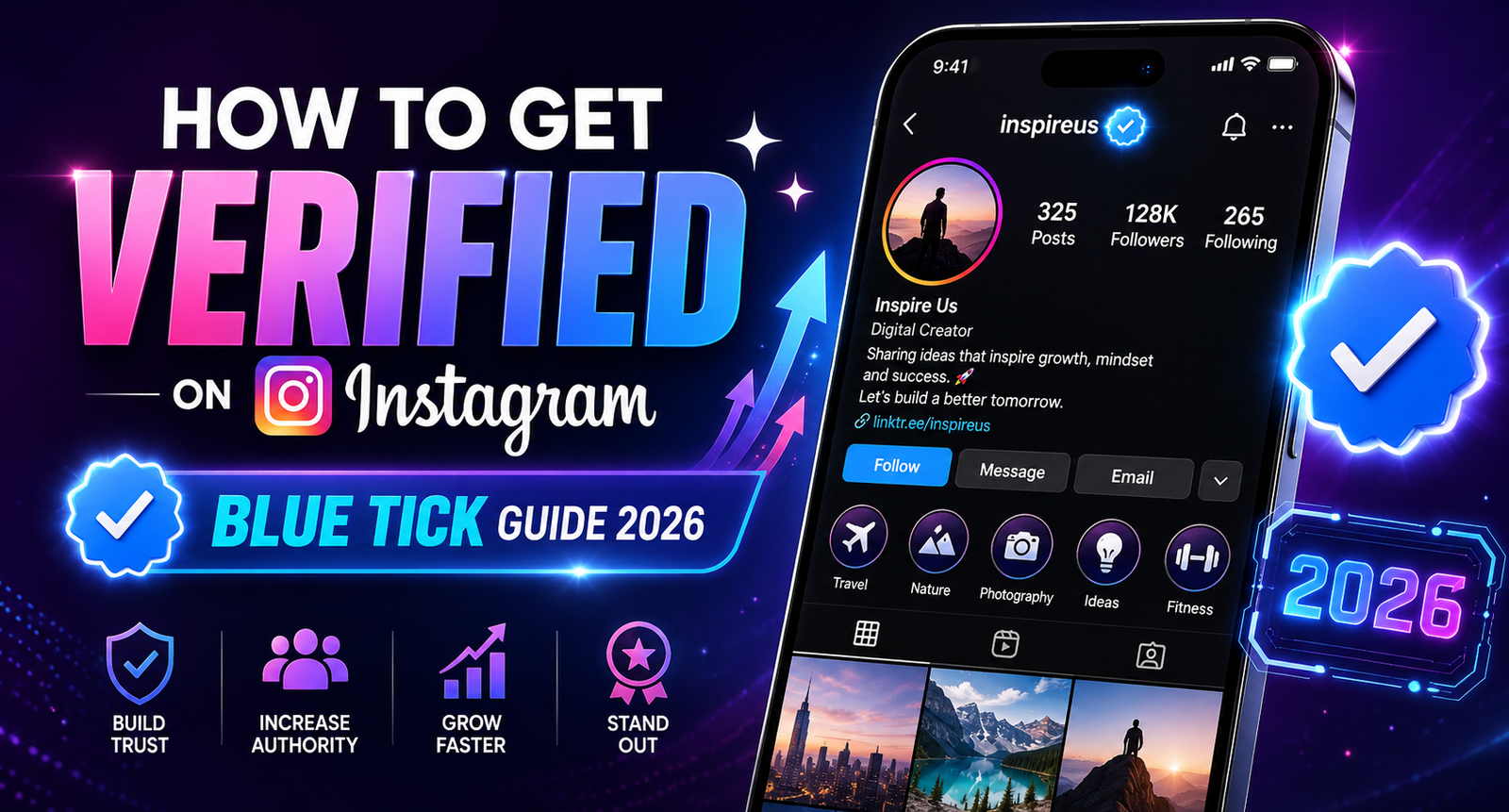
That little blue tick sitting next to an Instagram username carries more weight than most people realize. It tells every visitor — instantly and without explanation — that this account is real, reviewed, and trustworthy. For creators, brands, and businesses operating in a landscape crowded with fake profiles, AI-generated accounts, and impersonators, the verified badge has shifted from a vanity milestone to a genuine business asset.
The good news is that getting verified on Instagram in 2026 is more accessible than it has ever been. The process has changed significantly over the past few years, and today there are two clear paths to earning that blue checkmark. Understanding both — their requirements, their trade-offs, and which one suits your situation — is the first step to actually landing it.
What the Blue Tick Actually Means
Before getting into the how, it helps to understand the what. The Instagram blue check is a verification badge that confirms your account is the authentic presence of a notable public figure, brand, or business. It provides credibility, protects against impersonation, improves visibility in search and Explore, and helps you stand out from fake accounts or fan pages. The badge is officially reviewed and approved by Meta.
In a platform with over 2 billion monthly active users, that distinction matters enormously. A study shows that 80% of users are more likely to follow verified profiles, and verified businesses experience a 30% higher engagement rate than non-verified accounts. For anyone trying to build an audience or sell products, those numbers are not trivial.
Verification also has a practical defensive function. With AI-generated profiles and impersonation accounts becoming increasingly common, the blue tick is one of the clearest signals you can send that your audience has found the real you — not a copycat.
The Two Paths to Verification in 2026
There are two ways to get verified on Instagram in 2026. First, apply for free through Instagram’s traditional verification by going to Settings, then Request Verification, and submitting your ID and proof of notability. Second, subscribe to Meta Verified, a paid service that provides the blue checkmark along with account protection and support. Both methods require identity verification and a complete profile.
Both paths result in the same blue badge. No visitor can tell which route you used to get it — the checkmark looks identical regardless. What differs is the eligibility bar, the cost, the timeline, and what you get beyond the badge itself.
Path One: Free Traditional Verification (for Notable Figures)
This is the original route — the one celebrities, major brands, and public figures have used for years. It costs nothing to apply, but the requirements are selective and approval is far from guaranteed.
The Four Core Requirements
Your account must meet four core criteria to be approved through the traditional free verification process. It must be authentic, meaning it represents a real person, registered business, or entity — fan accounts, meme pages, and general interest accounts do not qualify. It must be unique, with only one account per person or business able to be verified, except for language-specific accounts. It must be complete, meaning the account is public, has a bio, a profile photo, and at least one post. And it must be notable, with Instagram defining notable as well-known and highly searched for.
Notability is where most applications fail. It requires external validation — Instagram is looking for evidence that people are actively searching for you outside of the platform itself. Instagram looks for media coverage in reputable news outlets, blogs, and industry publications; public interest signals showing that people actively search for your name or brand; search visibility such as Wikipedia pages or a Google knowledge panel; and community engagement reflecting strong follower loyalty and interaction patterns.
One important clarification: there is no minimum follower count. Accounts with fewer than 10,000 followers have been verified when they meet all verification requirements. On the flip side, some accounts with hundreds of thousands of followers remain unverified because they lack account notability or fail to meet other requirements. Instagram is looking for genuine public presence, not just a large number next to the follower count.
Step-by-Step: How to Apply for Free Verification
Open the Instagram app and go to Settings. Navigate to Account type and tools, then tap Request Verification. Fill out the form with your full name and upload a government-issued ID for individuals, or official business documentation for brands. Choose your account category, then add supporting links that prove your public presence, including press coverage, your website, or other verified social profiles. Submit your application and wait — you’ll typically receive a decision within 30 days.
The links section is arguably the most important part of the entire form. This is where you include links to press coverage, media features, notable achievements, or any coverage in publications that Instagram would recognize as credible. Fill it thoroughly. Do not leave optional fields blank — every piece of evidence you provide strengthens your case.
The review timeline for public figure applications is about 30 days, though you can be approved much sooner depending on the team reviewing those applications.
Path Two: Meta Verified (Paid Subscription)
Meta Verified is Instagram’s paid subscription program, and it dramatically lowers the barrier to getting a blue badge. You don’t need to be a celebrity or have media coverage. You need to be a real person, willing to pay a monthly fee, and able to pass an identity check.
Meta Verified subscription costs $11.99 to $14.99 per month in the US on a web-based plan, with prices varying by region. Premium tiers can cost up to $350 per month for businesses wanting advanced features. Web-based subscriptions are the most affordable option — iOS subscriptions cost more due to Apple’s in-app purchase fees.
Who Qualifies for Meta Verified
Meta Verified requirements include a public or private profile associated with your full name that has a profile photo including your face, a valid photo ID that matches your profile name and profile picture, two-factor authentication enabled on your profile, and compliance with Instagram’s Terms of Use and Community Guidelines. You also need to be at least 18 years old.
The notability bar disappears entirely with this route. As long as your identity checks out and your profile meets the basic requirements, the badge is available to you.
What Meta Verified Includes Beyond the Badge
Meta Verified includes the blue checkmark plus concrete features that justify the monthly cost for many users: identity verification with government ID confirmation that provides impersonation protection, dedicated priority customer service access for account issues, and an enhanced visibility boost in search rankings and recommendations.
The timeline is also much faster. Getting Meta Verified happens quickly — once you’ve made your first monthly payment, you can expect to see your blue check and all the other benefits on your Instagram profile within 48 hours.
One critical caveat: Meta Verified is a subscription, not a permanent achievement. Your badge exists only while you remain subscribed and compliant with Instagram’s guidelines. Cancel the subscription, and the blue tick disappears.
Step-by-Step: How to Sign Up for Meta Verified
Open the Instagram app and tap your profile icon. Tap the three-line menu in the top right corner, then select “Meta Verified” from the menu options. Follow the prompts to verify your identity by submitting a government-issued photo ID. Enable two-factor authentication if you haven’t already. Choose your subscription plan, confirm payment, and wait. The badge typically appears within 48 hours.
How to Strengthen Your Chances for Free Verification
If you’re pursuing the traditional free route and want to maximize your chances of approval, the following steps make a meaningful difference.
Build press coverage strategically. Instagram treats independent media mentions as the strongest signal of notability. This means features, interviews, and articles in reputable publications — not paid placements or press releases you distributed yourself. Reach out to journalists in your niche, contribute expert quotes to articles, or pitch your story to industry blogs. Instagram looks at independent press coverage from reputed news or media platforms as evidence of notability, and the Instagram review team often checks a brand’s presence on Google search when verifying notability.
Create a Wikipedia page. This is one of the most consistently cited notability signals across creator communities. A well-sourced, neutral article about your brand on Wikipedia shows legitimacy and notability beyond social media. The page must follow Wikipedia’s own notability guidelines, including verifiable references from credible sources — it cannot simply be a promotional overview you wrote yourself.
Build a cross-platform presence. A strong presence on multiple platforms signals that you are a notable figure, not just an active Instagram user. Verified accounts on Twitter, LinkedIn, or YouTube strengthen your Instagram verification case. The more consistently your name or brand appears across reputable digital spaces, the stronger the trail of evidence you create for Instagram’s reviewers.
Keep your profile in optimal condition. Complete every field in your bio. Post consistently and build genuine engagement. Instagram favors active, engaged accounts — engaging like a real human by replying to DMs, responding to comments, and interacting with your community helps signal authenticity. An account that looks abandoned or sparse sends the wrong signal to reviewers, regardless of how notable you are offline.
What Happens If Your Application Gets Rejected
Rejection is common — even for accounts that seemingly meet every requirement. As of late 2025, the notability bar has become more stringent. Users with significant media coverage, large followings, and multi-platform verification have reported continued rejections, suggesting Meta’s approval process is now more discretionary than purely merit-based.
If your application is denied, do not reapply immediately. You can apply again after 30 days, but applying for a verified badge multiple times within 30 days will automatically get your application rejected. Use that month to figure out ways of improving your chances rather than hoping for a different outcome without making changes.
Use the 30-day window productively. Secure more media coverage. Grow your cross-platform presence. Strengthen your Wikipedia page. Then reapply with an updated, more compelling set of supporting links. Many creators who now hold a verified badge were rejected on their first one, two, or even three attempts before finally being approved.
One Thing to Always Avoid
Many third-party sites claim to offer a shortcut to Instagram verification, but these are almost always scams. Instagram does not work with outside companies or proactively offer verification to users, and engaging with such services puts your account and personal information at serious risk. The only legitimate path to verification is through Instagram’s official in-app request process.
If someone reaches out claiming they can get you verified for a fee — through a contact at Instagram, a “fast-track” service, or any other means — that is a scam. Do not engage. The consequences range from losing money to having your account permanently compromised.
Which Path Is Right for You?
The choice between free verification and Meta Verified comes down to where you are right now. If you have genuine press coverage, a strong cross-platform presence, and a profile that Instagram would recognize as publicly notable, the free route is worth pursuing — it costs nothing, and a freely earned badge carries slightly stronger credibility signals in the creator community.
If you’re a creator, small business owner, or professional who doesn’t yet have significant media coverage but wants the trust and protection that comes with a verified badge, Meta Verified is a reasonable investment. At roughly $12 to $15 per month, the combination of identity protection, priority support, and boosted visibility can pay for itself fairly quickly — particularly for accounts using Instagram as a business channel.
In 2026, the blue tick is no longer exclusively for the famous. It is a practical tool for anyone who wants to establish trust, protect their identity, and signal authenticity in an increasingly crowded and imitation-prone platform. Whether you earn it through notability or subscription, what matters is that you pursue it through the right channels and build the kind of presence that makes the badge feel inevitable.