
Key Takeaways
- Beginners will be advised to post 2–3 YouTube Shorts per week so as to avoid fatigue.
- For growing creators, posting 5–7 Shorts per week can be achieved as long as strong hooks, editing, and clear topics are maintained.
- Established creators can publish 1 Short a day when they already know their audience and analytics.
- This can negatively impact your channel if you’re posting too many low-quality Shorts, as poor retention and low engagement will diminish reach.
- The optimum timing depends on your target audience, but 6–9 PM on days of the week and 10 AM–1 PM on weekends will give you a good reference point.
Intro
One of the quickest methods for testing concepts, connecting with new audiences, and boosting a YouTube channel in 2026 is by utilizing YouTube Shorts. One question, however, still hasn’t got a clear answer for many creators:
How many times should you create YouTube Shorts?
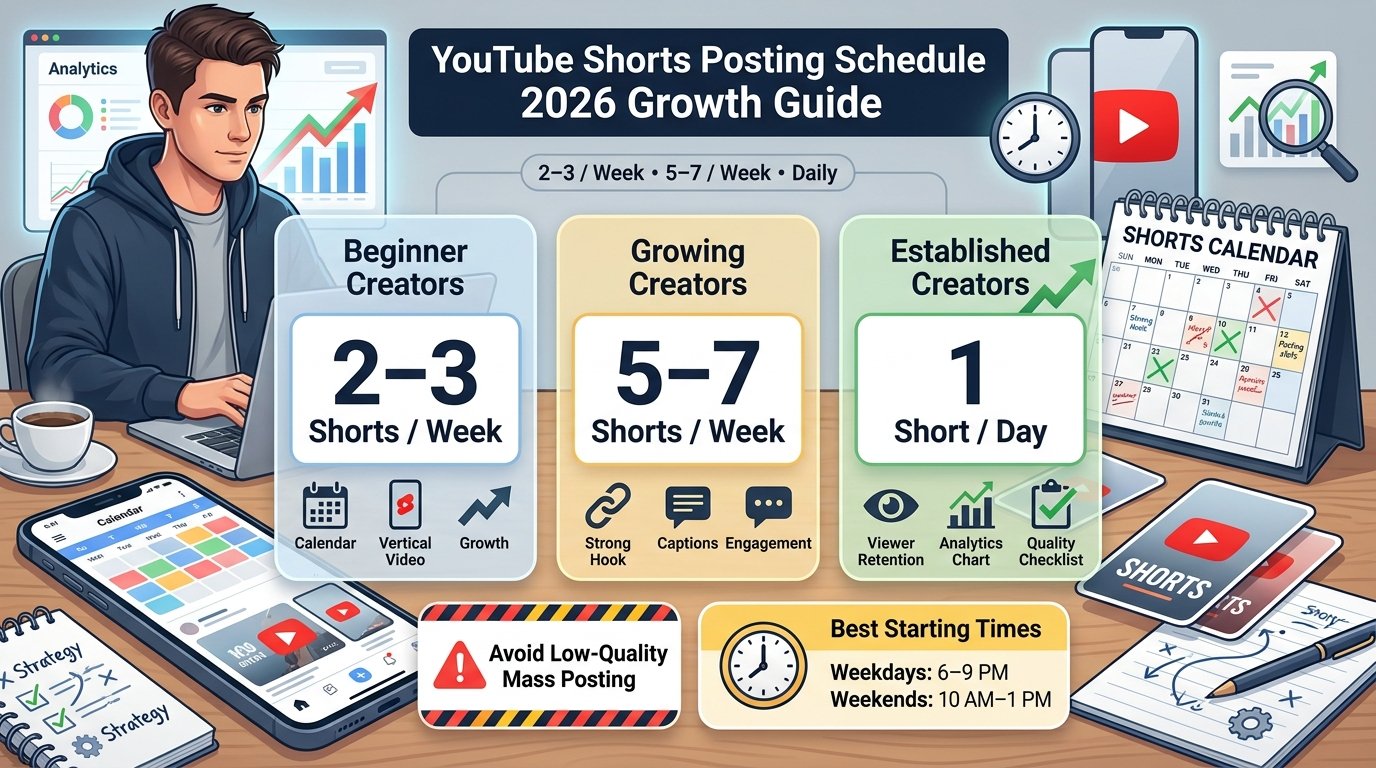
The answer is fairly simple and as a beginner, you want to post 2–3 Shorts per week, as a growing creator, 5–7 Shorts per week, and as an established creator, 1 Short every day.
You should start posting this often to keep the balance of quality, consistency, engagement and growth just right. The more you post your Shorts, doesn’t necessarily equal increased growth. Low content quality means viewers might skim through rapidly and that will impact performance.
Short Summary
For creators, YouTube Shorts can be the key to charge and expand their process at a quicker rate, making them more noticeable, testing content thoughts, and drawing in new subscribers. The best time to post a video will vary depending on your channel size, niche, video quality, and resources. Beginners should aim for 2–3 Shorts a week; growing creators should post between 5 and 7 Shorts per week, and creators with a sizable following can post daily as long as the quality is high.
What Are YouTube Shorts?
YouTube Shorts are vertical videos, made for a short duration of viewing and quick discovery. They are optimized for mobile-first viewers, but can be seen throughout YouTube, including in the Shorts feed, channel pages, YouTube search and recommendations.
For YouTube growth, Shorts play a pivotal role in 2026. According to YouTube, short-form video is now achieving on average more than 200 billion views a day, demonstrating the incredible reach that short-form video has gained for creators, brands and businesses.
YouTube Shorts is now expanded to 3 minutes but the majority of creators are seeing great success with videos 15 to 45 seconds in length. It’s much easier to complete shorter videos, rewatch, and, at least at first, more consistently create videos of a shorter length.
How often you should post on YouTube Shorts varies based on how you’re doing.
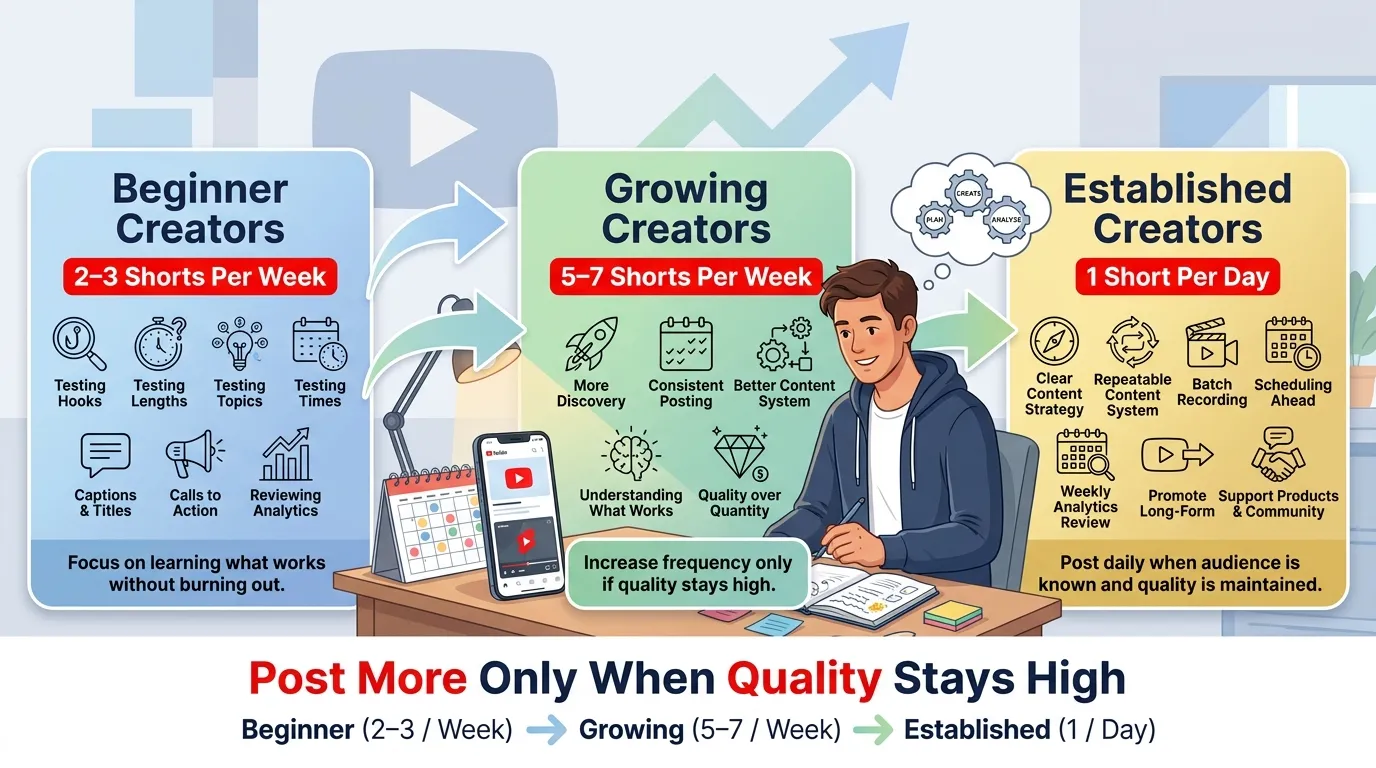
Beginner Creators: Post 2–3 Shorts Per Week
When you’re beginning your YouTube channel, it’s a good and realistic idea to share 2–3 Shorts a week.
This will ensure that you have plenty of material for experimenting without becoming overly daunting. As a novice, you should not be focussing on uploading everything you can. The key objective should be to educate yourself about what your viewers want to see.
You can test 2–3 Shorts per week:
- Different hooks
- Different video lengths
- Different topics
- Different posting times
- Various captions and titles
- Various calls to action
This schedule also allows you the time to watch YouTube Analytics and pinpoint how to improve your next videos.
Growing Creators: Post 5–7 Shorts Per Week
If your channel already has a number of views, comments, and subscribers, you can start posting 5–7 Shorts per week and the posts will start increasing.
Your content system will be stronger at this stage. You should now have a good understanding of what works and what videos your viewers are skipping.
Posting almost every day allows you to be seen more often and caters to your discovery. Nevertheless, there is a need for quality. It is better to have 1 good 5 Short week rather than upload 20 weak Shorts.
Established Creators: Post 1 Short Per Day
For established creators with clear content strategy who have adequate resources, they can post 1 Short per day.
Daily posting is ideal when you know your audience, have some sort of repeatable content, and can keep it at a high level. Many existing content creators batch-record Shorts, schedule them ahead of time, and then check the performance on a weekly basis.
In order to keep your channel alive between the long-form uploads, you can begin doing daily Shorts. They could likewise be utilized for the advancement of full recordings, merchandise, suites, or community posts.
How Many YouTube Shorts Should You Post Per Day?
For most creators, 0–1 YouTube Short per day is recommended.
In most niches, you need to post just once a day. This provides YouTube with regular content for testing and gives your audience a sufficient amount of space.
If your niche is a swiftly moving one, you can submit a number of Shorts every day, like:
- News
- Sports
- Gaming
- Entertainment
- Trends
- Comedy
- Breaking updates
But multiple posts are not good for everyone. With educational, business-based, product-based, and tutorial-based content, fewer quality Shorts might be better.
Should You Post Multiple YouTube Shorts a Day?
Yes, you can publish multiple YouTube Shorts daily; however, provided every Short has value.
Multiple uploads a day can work if you have a great system, quick production times, and an audience that wants to see a lot of new content. However, too much posting can be an issue for many creators.
Excessive use of Shorts can result in:
- Lower video quality
- Repetitive content
- Weak hooks
- Audience fatigue
- Lower engagement
- Creator burnout
There is no confirmation from YouTube about a simple hit for frequent uploads, and when viewers quickly swipe out of your videos then your reach will suffer. By itself, more posting isn’t a problem. The issue is that there is too much flaky content.
Should You Post a YouTube Short Every 3 Hours?
For most creators, posting a YouTube Short every 3 hours is too much.
While such a calendar may be suitable for large media teams, news pages, sport pages or trend-driven channels, it is not a beneficial strategy for beginners.
Frequency of posting may lower your chance to plan, edit, review and revamp. It can also overwhelm your subscribers if the material is not compelling enough.
It’s better to post fewer Shorts and strengthen them more.
What If You Upload 100 YouTube Shorts Daily?
For most creators, making 100 YouTube Shorts per day isn’t a good idea.
With all of the resources to produce that type of content, it’s tough to maintain high quality. It’s possible to upload redundant, low production value, or poorly edited videos.
This can have a negative impact on your channel, and your viewers can lose interest, fast-forward your videos or swipe away.
Don’t post 100 Shorts every day. Create a repeatable system:
- Research 10 strong ideas.
- Write simple hooks.
- Record in batches.
- Edit with captions.
- Schedule 3–7 Shorts per week.
- Analyse weekly.
It is a more viable approach that is better for growth on a sustained basis.
Can Posting Too Many Shorts Harm Your Channel?
Yes, too many low-quality Shorts videos can negatively impact your channel.
The problem isn’t the amount of uploads. The actual problem is viewer response. Failure to watch, like, comment, share or re-watch your Shorts can make it difficult to get the content seen by more viewers.
An effective Shorts strategy will place emphasis on:
- Strong opening hook
- Clear topic
- Fast pacing
- Good captions
- Simple editing
- Strong ending
- Viewer retention
- Audience engagement
A combination of quality and consistency can help your channel to flourish.
The optimal time to post YouTube Shorts can vary depending on when your followers are most likely to be watching.
This is a good starting point:
- Weekdays: 6 PM to 9 PM
- Saturday and Sunday: 10 AM to 1 PM
These time blocks are successful since many people have time after work, after school or during laid-back weekend hours. But that’s just a beginning. The best time should really come from YouTube Analytics.
On YouTube Studio, look at when your audience is most active. Then try various posting times for a minimum of 2 weeks.
Track:
- Views
- Average view duration
- Retention
- Likes
- Comments
- Shares
- Subscribers gained
- Rewatches
Not only is the best time when you get the most views. It is the period your Shorts see the maximum engagement and retention.
Best Days to Post YouTube Shorts
Flexibility for content types means different days may be effective for different types of content.
Monday
Ideal for productivity, business, motivational, and educational material.
Tuesday
Ideal for tutorials, tips, evergreen content, and creator tips.
Wednesday
Great for education Shorts, mid-week motivation and problem-solving videos.
Thursday
Well-suited for SaaS, eCommerce, and content about business tips and creator economy.
Friday
Suitable for entertainment, lifestyle, humour and weekend-related content.
Saturday
Suitable for gaming, family, comedy, traveling, lifestyle and casual viewing.
Sunday
Ideal for making plans, motivation, personal growth content, relaxed content and weekly recaps.
YouTube Shorts can be 3 minutes, but it doesn’t necessarily imply greater.
The optimal length will typically be between 15–45 seconds for most creators. This is a length that won’t lose audience interest and is long enough to offer value.
Various niches may need various lengths:
- Humor: 7–20 seconds
- Quick tips: 15–30 seconds
- Tutorials: 30–60 seconds
- Storytelling: 30–90 seconds
- Product demos: 20–45 seconds
- Educational Shorts: 30–60 seconds
The point isn’t necessarily to make the video as long as possible. Its aim is to get the viewers to the end.
How to Create a Balanced YouTube Shorts Content Calendar
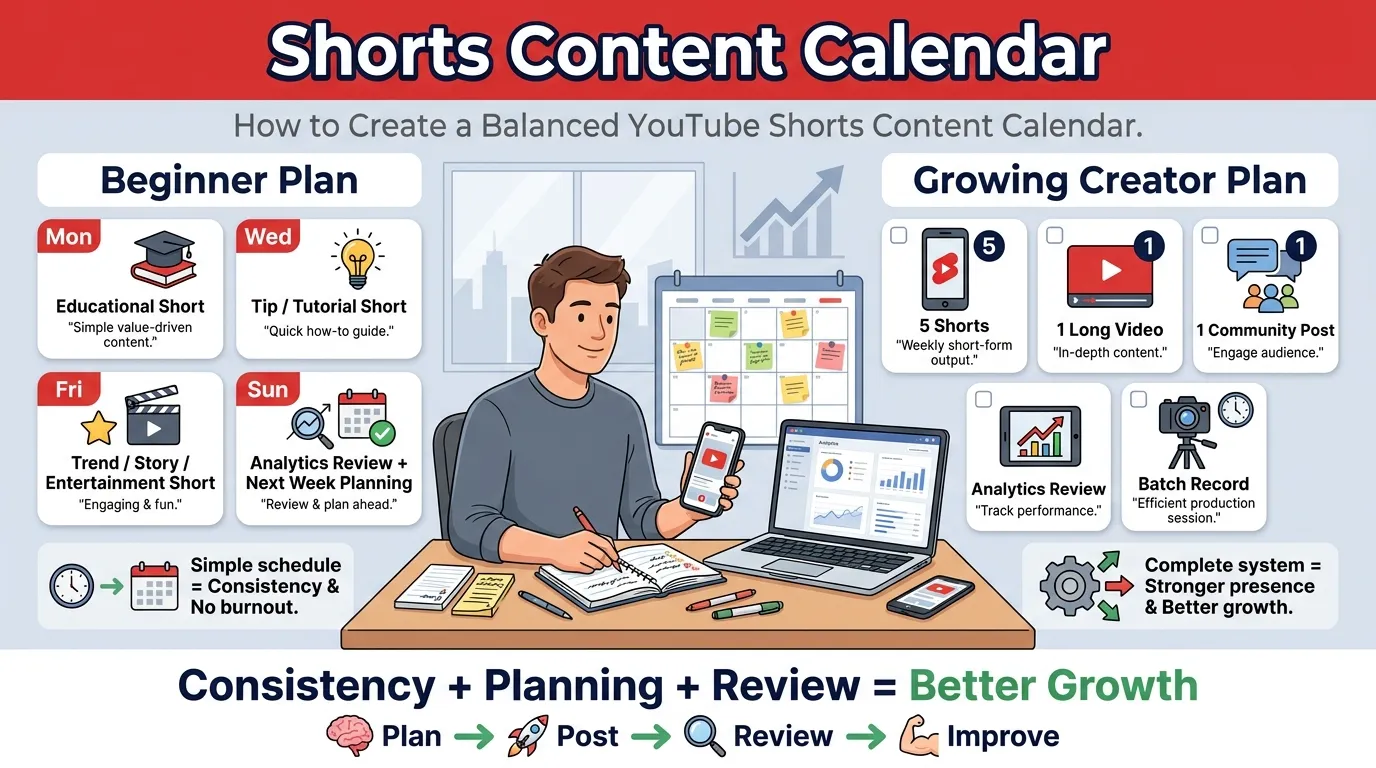
Use a YouTube Shorts content calendar to help you remain consistent.
Let’s propose a plan which is suitable for beginners:
- Monday: Educational Short
- Wednesday: Tip or tutorial Short
- Friday: Trend, story or entertainment Short
- Sunday: Review analytics and plan next week
A more robust weekly strategy might be something like this for growing creators:
- 5 Shorts per week
- 1 long-form video
- 1 community post
- 1 analytics review
- 1 batch recording session
This will help your channel stay alive as opposed to relying solely on Shorts.
Tips to Make Better YouTube Shorts
Start With a Strong Hook
It’s the first few seconds that count the most. Use a question, result, mistake or surprising statement for your opening.
Examples:
- “Don’t do it on YouTube Shorts.”
- “This is why you are not receiving a ton of views on your Shorts.”
- “I tried 3 posting times. Here are some of the times that work!”
- “This is the mistake that most beginners make when it comes to Shorts.”
Keep the Topic Clear
Don’t overstuff one Short by covering too many points. 1 Short should have 1 main idea.
Use Captions
Many people view videos with no audio. Captions make it easy for viewers to understand your message quickly.
Add Fast Visual Changes
Every few seconds, alter the visual, angle, text or scene to maintain attention.
Create a Perfect Loop
A good loop will get people to watch again. This can be achieved by providing a video ending or conclusion related to how the video started.
Use One Call to Action
Don’t request viewers to like, comment, subscribe, share and watch another video all at once. Have one call to action.
Examples:
- “Comment your posting schedule.”
- “Sign up for additional tips about building a YouTube channel.”
- “Check out the complete tutorial on my channel.”
- “Save this for your next upload.”
Use Relevant Hashtags
Provide 2–4 hashtags that correspond to your article. Avoid over-hashtagging the description.
Examples:
- #YouTubeShorts
- #Shorts
- #YouTubeGrowth
- #ContentCreator
How YouTube Shorts Monetization Works
While it is possible to monetize on YouTube Shorts, generally the revenue from ads in YouTube Shorts is less than that of a long-form video.
According to YouTube, creators retaining 45% of their assigned funds for Shorts ads from the Creator Pool are able to monetize. Earnings will vary by country, niche, views, music usage, audience and demand from advertisers.
The estimates for how much creators earn from Shorts range anywhere from $0.01 to $0.06 per 1,000 viewers, depending on the individual. This does not imply that it should be the only method of getting cash out of Shorts.
Another way to monetize Shorts is by using:
- Affiliate marketing
- Digital products
- Sponsorships
- Brand deals
- Coaching or services
- Selling your own business/products
- Directing viewers towards longer-form videos
With reach in mind, Shorts are often more effective, but longer content can be more effective if you want to build more trust and be even more successful in monetizing.
How Many Views Do YouTube Shorts Get?
How many views do YouTube Shorts get can vary a lot.
Some Shorts will only get a handful of views. Others can number thousands, millions and much more. You need to consider factors like niche, hook, retention, topic, timing, and audience response when it comes to performance.
Don’t be surprised if a Short gets only 100 views. If your retention is good and increased your comments or subscribers, then the Short provided you with useful data.
Shift the focus from “how many views did I get?” to:
- Did people watch it till the end?
- Did they like/comment?
- Did they subscribe?
- Did they rewatch?
- Has this topic done better or worse than other topics?
Using analytics, you can work on your next upload.
Best YouTube Shorts Strategy for Beginners
If on the basecamp mode, then adhere to this easy 60-day method of making your videos on YouTube Shorts.
Weeks 1–2: Test Basic Topics
Post 2–3 Shorts per week. Test out new content topics and find out what sticks.
Weeks 3–4: Improve Hooks
Take some time to look at the first few videos. Identify points of audience drop-off. Increase your strength in the first 3 seconds.
Weeks 5–6: Repeat What Works
Make additional Shorts based on popular topics. Maintain identical style but enhance editing and pacing.
Weeks 7–8: Increase Slowly
Increase from 2–3 Shorts per week to 4–5 Shorts per week if your quality is high.
Don’t go posting more often until you’ve got your content working for you.
Quality vs Quantity: Which Matters More?
More is less; less is more.
An efficient Short can continue to work for days, weeks or even months. If viewers aren’t interacting with it, then it can fade in no time, even when it comes to a weak Short.
Quality and consistency are both important components of a successful YouTube Shorts marketing campaign. You should be posting enough to build up some statistics, but not so much as to present lazy, duplicated content.
Remember this rule:
Post more only when quality is still high.
Final Recommended YouTube Shorts Posting Schedule
The absolute best routine for posting in 2026 is below:
- Beginner: 2–3 Shorts per week
- Growing creator: 5–7 Shorts per week
- Established creator: 1 Short each day
- Fast trend niche: 1–3 Shorts per day if quality is still high
- Avoid: posting every 3 hours or mass low-quality Shorts
This schedule allows you to have continuity and not overwork yourself.
FAQs About YouTube Shorts Posting Frequency
How often should I post YouTube Shorts?
For beginners, it is suggested to post 2–3 Shorts per week. Growing creators are allowed to create 5 to 7 Shorts every week. Existing creators can post 1 Short per day provided they are able to sustain quality.
Is it good to post YouTube Shorts every day?
Yes, daily posting can be effective if each Short has a strong hook, good retention, and a clearly defined topic. It is better to post less if the quality is not up to standard.
Can I post multiple YouTube Shorts per day?
Yes, but only when you have a niche where you have content often, and your audience engages. Multiple Shorts per day is best suited for trends, news, sport, games, or entertainment.
What is the best time to upload YouTube Shorts?
First try 6–9 PM weekdays and 10 AM–1 PM on weekends. Then view the top time of the day for your own viewers in YouTube Analytics.
How long should YouTube Shorts be?
While the YouTube Shorts you can create are up to 3 minutes long, many creators make their videos between 15 and 45 seconds as completion and rewatch speeds are greater for shorter videos.
Can posting too many Shorts hurt my channel?
Yes, having too many low-quality Shorts can negatively affect your channel since viewers might scroll past, overlook your videos, or simply lose interest in your channel.
Summary
In 2026, the ideal YouTube Shorts posting frequency will likely vary based on the stage of your channel, the quality of your content, audience engagement, and niche.
For beginners, 2–3 Shorts per week. For a growing channel, go for 5–7 Shorts weekly. If you are comfortably established and maintaining quality levels, then post 1 Short every day.
Don’t focus solely on volume. Pay attention to powerful hooks, clear topics, great editing, how to hold viewers and steady improvement.
How Often Should You Post YouTube ShortsWhile more Shorts content will help you grow faster, the secret is definitely not to post more. The real secret is to post better, learn from the information given in the analytics, and persevere enough to realize what your viewers are paying attention to.