
If you’ve ever uploaded a YouTube video and watched it sit there with barely any views while similar content from other creators takes off, timing might be a bigger factor than you think. Most creators obsess over thumbnails, titles, and video quality — all important — but quietly ignore one of the simplest levers available to them: when they hit publish.
This guide breaks down everything you need to know about the best time to post on YouTube in 2026, backed by real data, so you can stop guessing and start growing.
Table of Contents
ToggleWhy Upload Timing Actually Matters
Before jumping into specific hours and days, it’s worth understanding the mechanism behind why timing influences your results in the first place. YouTube’s algorithm doesn’t treat all videos equally at upload — it runs them through a staged evaluation process that begins the moment you go public.
When you publish a video, YouTube shows it to a small sample of your existing subscribers and recent viewers first. It then watches how that group behaves. Do they click on the thumbnail? Do they watch more than half the video? Do they like, comment, or share? If those early signals are strong, YouTube expands the video’s reach — pushing it to browse feeds, suggested video slots, and eventually to non-subscribers who’ve never heard of your channel.
When a video collects strong watch time and click-through rate in the first few hours, it keeps expanding for days. When it launches flat, it rarely recovers.
That’s the core problem with posting at the wrong time. If you upload when your audience is asleep or stuck at work, your test pool shrinks. The early engagement signals are weak, and YouTube interprets that as the video not being worth promoting. A video that could have reached 100,000 people quietly dies at 3,000 — not because it was bad, but because nobody was around to give it the early push it needed.
In 2026, the viral window — the period where a video gains traction — is 24 to 36 hours, down from the 3 to 5 days typical in 2022 and 2023. That compression makes timing more critical than ever. Miss the early engagement wave, and your video may never reach the second stage of recommendations at all.
The Golden Rule: Publish Before the Peak, Not During It
This is the single most important timing insight, and most creators get it backwards. They wait until peak viewing hours to upload, thinking that’s when their video will be seen. In reality, by the time they publish, the peak is already happening — and there’s no runway.
Publishing 2 to 3 hours before your audience’s peak viewing window gives YouTube’s algorithm time to index, test, and start surfacing your video right when traffic surges.
Think of it like opening a shop. You don’t unlock the doors at noon when customers are already standing outside. You open at 10 AM, stock the shelves, run a few transactions, and by noon you’re already operational with positive reviews. By the time your video hits peak traffic, it already has watch time, likes, and a strong CTR — and YouTube is actively recommending it to new viewers.
So if your audience peaks at 7 PM, your target upload window is around 4 to 5 PM. That two-to-three-hour buffer is where your growth lives.
Best Days to Post on YouTube
Not all days are created equal when it comes to YouTube performance. Here’s what the data consistently shows across multiple large-scale creator studies in 2025 and 2026.
Thursday and Friday are the top-performing days for most channels. Audiences are in a pre-weekend mindset, more relaxed and more likely to browse and watch longer-form content. Videos posted on these days tend to accumulate views on Saturday and Sunday, the platform’s highest-traffic days. That’s the real strategy here — you’re not just optimizing for Thursday. You’re positioning your video to ride the weekend wave when viewership peaks across the entire platform.
Wednesday is close behind and is often cited as the most consistent mid-week performer. Across campaign data, mid-week uploads deliver stronger engagement and more stable performance. Wednesday works especially well for educational content, tutorials, business channels, and anything targeting an audience in a learning mindset during the work week.
Saturday and Sunday have the highest raw viewership on the platform — people have more free time and are in a relaxed, watch-anything mood. However, these days are also the most competitive, because many creators think the same way and schedule their best content for weekends. The smarter play is to post on Thursday or Friday so your video is already indexed, tested, and gaining momentum by the time Saturday rolls around.
Monday and Tuesday are generally the weakest days, particularly for entertainment, gaming, and lifestyle content. Work and school routines dominate these days, leaving less room for casual browsing. That said, they can work reasonably well for news-adjacent content, productivity channels, or anything that suits someone’s Monday-morning routine.
Best Times to Post on YouTube: Long-Form Videos
For standard YouTube videos — tutorials, vlogs, reviews, documentaries, explainers — the data points to a fairly consistent window.
The best time to post on YouTube in 2026 is between 2 PM and 4 PM on weekdays for long-form videos, with Wednesday through Friday consistently generating the highest engagement.
This window works because it gives your video several hours to build momentum before the evening peak, which typically hits between 7 PM and 9 PM local time. By the time your audience settles in for their nightly YouTube session, your video has already passed its initial algorithm evaluation and is being actively recommended.
For weekends, the optimal window shifts earlier. Weekends — 9 AM to 11 AM or 12 PM to 3 PM on Saturday and Sunday — often outperform other slots for longer watch sessions, especially entertainment, lifestyle, or family content. Weekend viewers start their YouTube sessions earlier in the day and have more time to watch longer content without interruption.
The general rule for long-form videos across all days: post between 12 PM and 4 PM in your audience’s primary time zone. If you’re unsure which time zone your audience skews toward, check your YouTube Analytics geography report — it will tell you exactly where your views are coming from.
Best Times to Post YouTube Shorts
Shorts follow a completely different consumption pattern, and they need a completely different posting strategy. Unlike long-form videos, which viewers seek out intentionally, Shorts are built for interruption — they reach people who are casually scrolling, often on mobile, during short breaks in their day.
Long-form videos perform best in the mornings (8 to 11 AM), with Sunday, Tuesday, and Monday as the strongest days. YouTube Shorts perform best in the evenings (6 to 9 PM), with Friday, Saturday, and Thursday as the strongest days. There’s almost no overlap — which is actually good news if you’re publishing both formats. You can schedule long-form content for morning uploads and Shorts for evening drops without competing with yourself.
The best time to post YouTube Shorts in 2026 is 11 AM to 2 PM and 6 PM to 9 PM. These hours align with high mobile activity — lunch breaks and after-work scrolling. Shorts perform best when people are casually browsing for quick entertainment or bite-sized education, not when they’re sitting down for a focused viewing session.
Best Posting Times by Content Niche
General data gives you a starting point, but your niche shapes viewer behavior significantly. Here’s how timing shifts by content type.
Gaming content tends to perform best in the evening — typically between 7 PM and 11 PM — when players are done with school or work and are in a gaming mindset. Weekends are strong all day for gaming channels.
Educational and tutorial content performs best during early afternoons and late mornings, particularly on weekdays. Educational content and tutorials align with when students or learners have free time. Wednesday and Thursday afternoons are particularly effective for this category.
Fitness and health content sees stronger engagement in the mornings or early evenings, mirroring the times when viewers actually work out. A 6 AM or 7 AM upload can work well for fitness creators whose audience checks workout videos before heading to the gym.
News and commentary operates on its own timeline entirely. For topical content, timing relative to the news cycle matters more than any general schedule. If something significant happens at 2 PM, posting a commentary video at midnight is already too late. Relevance beats schedule for this category.
Business and finance content performs well during lunch breaks and early afternoons on weekdays, when professionals are in a work mindset and likely to engage with content that feels productive.
How to Find Your Personal Best Posting Time
General data tells you where to start. Your YouTube Analytics tells you where to actually be. Here’s the exact process to find your channel’s optimal window.
Open YouTube Studio and navigate to Analytics, then click the Audience tab. Scroll down to the section labeled “When your viewers are on YouTube.” You’ll see a heat map showing when your specific audience is most active, broken down by hour and day of the week. The darker the color, the higher the activity.
Look at the peak hours in that heat map, then subtract 2 to 3 hours. That is your target upload window. Upload your video and set it to public at that target time — you want the video live and gathering momentum as the peak approaches.
Track your performance over 90 days. Compare videos posted at different times and look for patterns — most channels find a clear winner after enough data points. Then revisit your strategy every quarter, because audience behavior shifts seasonally around holidays, school calendars, and cultural events.
Consistency Matters More Than Perfect Timing
Here’s the thing most timing guides don’t tell you: finding the perfect hour is less important than showing up at the same time every week. The YouTube algorithm in 2026 places increased weight on consistent posting schedules. Channels that upload at predictable intervals build stronger subscriber conditioning. When your audience knows to expect new content every Thursday afternoon, they are more likely to check their feed, generating early engagement signals the algorithm loves.
Consistency also signals reliability to the algorithm itself. Channels with erratic posting histories tend to see lower average impressions per video than channels that stick to a regular schedule, even when total video counts are similar. A well-executed weekly upload at the same time beats a chaotic daily upload strategy every single time.
The Bottom Line
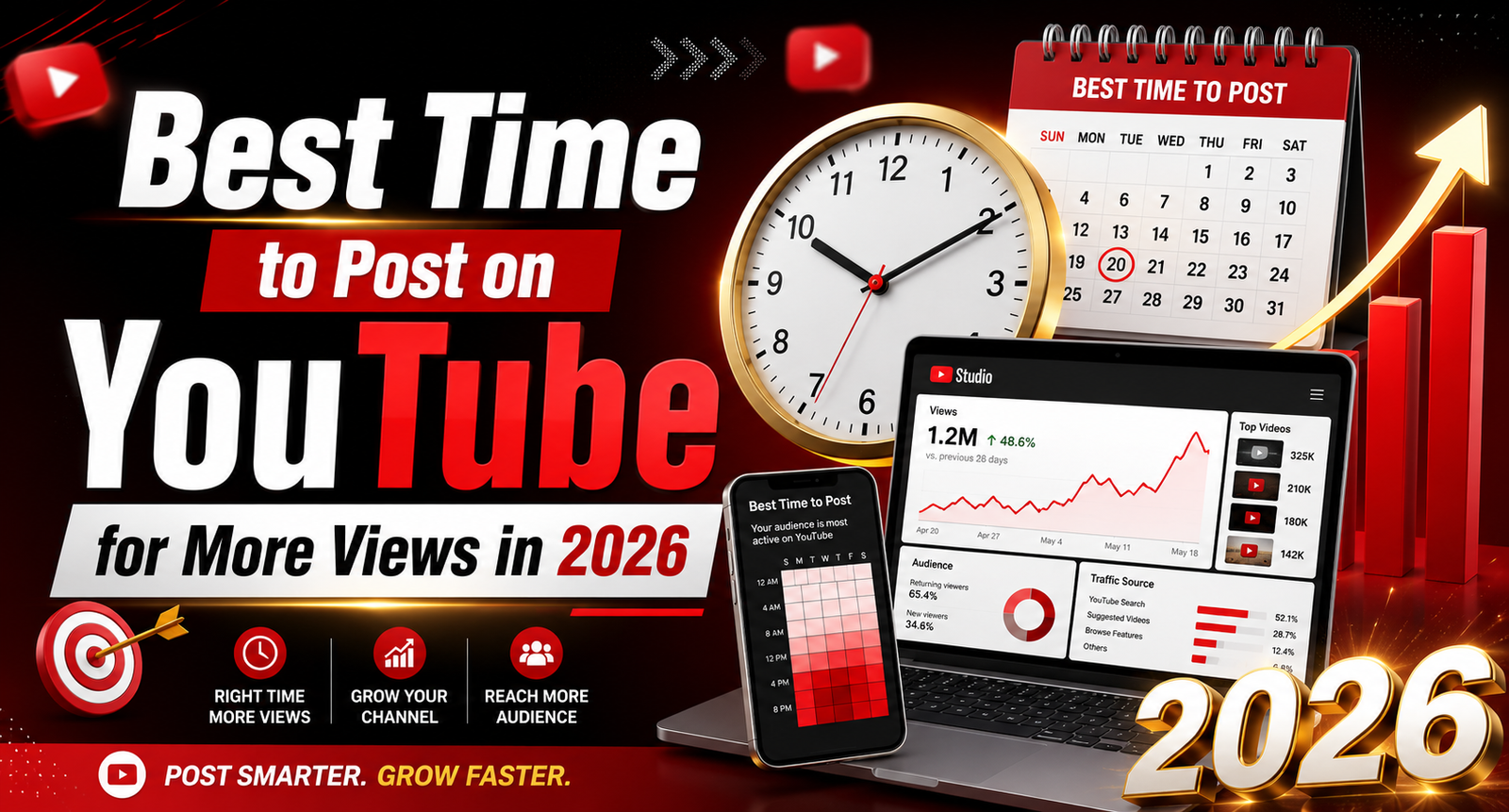
The best time to post on YouTube in 2026 is between 2 PM and 4 PM on weekdays for long-form videos and 12 PM to 3 PM or 7 PM to 9 PM for Shorts, with Wednesday through Friday consistently generating the highest engagement.
But those are starting points, not rules set in stone. The real answer lives in your own YouTube Studio analytics. Use the general data to form your first hypothesis, post consistently for two to three months, then let your audience behavior — not a generic chart — tell you where your sweet spot actually is. Timing amplifies quality content. It won’t save a bad video, but it can absolutely be the difference between a good video that gets seen and a great video that doesn’t.