
Two giants. One format. A definitive look at which platform delivers better reach, revenue, and staying power for creators and brands in 2026.
Short-form video is no longer an experiment — it is the primary format of the internet. Whether you’re a solo creator, a marketing team, or a brand trying to reach younger audiences, the choice between YouTube Shorts and TikTok is one of the defining decisions of 2026. Both platforms have matured dramatically, invested heavily in creator tools, and now compete for the same finite pool of human attention.
But they are not the same. Each platform rewards different behaviors, serves different audiences, and pays creators differently. Understanding those differences isn’t just useful — it’s the difference between growing an audience and shouting into the void.
This article breaks it all down across eight critical dimensions: audience size, algorithm mechanics, monetization, creator tools, SEO, shopping features, regulatory risk, and — most importantly — which platform is right for your goals in 2026.
Table of Contents
Toggle1. Audience Size & Reach
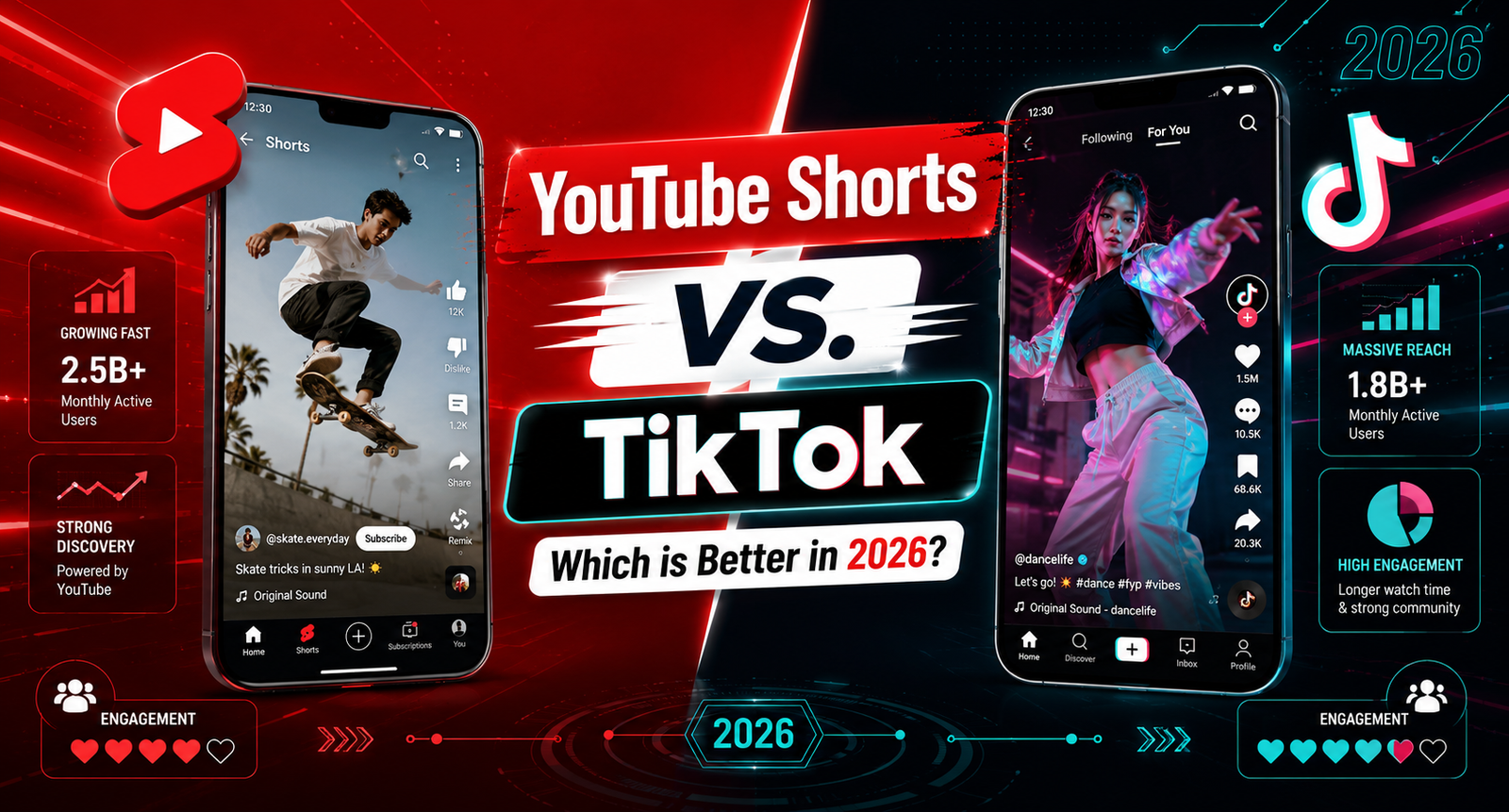
By raw numbers, both platforms operate at a scale that was unimaginable just five years ago. YouTube Shorts now generates over 200 billion views per day, a figure that has grown roughly 186% since early 2024. That surge is largely explained by YouTube’s existing infrastructure: the platform is simply converting its 2 billion monthly logged-in users into Shorts viewers, rather than acquiring entirely new audiences. Notably, 74% of Shorts views come from non-subscribers, making it a surprisingly powerful discovery engine.
TikTok, for its part, has reached approximately 1.9 billion monthly active users globally by early 2026, with more than 1 billion daily active users. Users spend an average of 95 minutes per day on the app — one of the highest session durations of any social platform on earth. In the US alone, TikTok reaches nearly half of all adults.
2. The Algorithm: How Each Platform Distributes Your Content
TikTok’s For You Page
TikTok’s algorithm is built on an interest graph, not a social graph. It pushes content to non-followers based almost entirely on early engagement signals: watch time, completion rate, shares, and comments. A brand-new account with zero followers can go viral on day one if the first few seconds of a video hold viewers’ attention. This has been TikTok’s most celebrated — and most copied — feature since 2020.
A key change in 2026: TikTok now shows new videos to existing followers first before wider distribution. This slightly reduces the “instant viral from zero” advantage that defined the platform’s early years, but the For You Page still offers more rapid viral potential than any other major platform. However, TikTok optimizes for immediate engagement — most of a video’s algorithmic impact happens in the first 24 to 48 hours.
YouTube Shorts’ Recommendation System
YouTube Shorts operates within YouTube’s broader ecosystem, which means it benefits from subscriber relationships, search intent, and long-form channel authority in ways TikTok simply cannot replicate. Crucially, Shorts and long-form content are evaluated by separate recommendation systems. A Short that performs poorly will not damage your main channel’s standing — making Shorts a genuinely low-risk testing ground for new ideas.
The key advantage: a Short can continue accumulating views for weeks or months through search and recommendations. YouTube Shorts optimizes for sustained performance over time, whereas TikTok optimizes for a short, explosive burst.
3. Monetization: Where Creators Actually Earn
Monetization is where creator decisions get serious. The two platforms differ not just in how much they pay, but in how the whole system is structured.
YouTube Shorts offers creators a 45% share of ad revenue through a pooled model — the same fundamental mechanism that has made YouTube the dominant platform for long-term creator income for nearly two decades. Critically, Shorts monetization integrates with the rest of a creator’s YouTube income: channel memberships, Super Thanks, merchandise, and long-form ad revenue all stack on top of Shorts earnings.
TikTok pays through its Creator Rewards Program, which offers roughly $0.40 to $1.00 per thousand views — but only for videos over one minute, immediately disqualifying most short-form clips. On a pure RPM basis, YouTube Shorts consistently pays 40–80% more per thousand views than TikTok across virtually every content niche in 2026.
That said, RPM alone doesn’t tell the full story. TikTok’s algorithm is generous at distributing content to non-followers, which means raw view counts are often much higher on TikTok — particularly for newer creators. A video that earns $15 on TikTok from 500,000 views can outperform a video earning $9 on YouTube from 150,000 views, despite TikTok’s lower per-view rate. Volume matters.
TikTok’s biggest monetization story, however, is social commerce. TikTok Shop crossed $15 billion in US sales in 2025, with projections exceeding $20 billion in 2026. Its in-feed shopping with native checkout creates a nearly frictionless path from video discovery to completed purchase. For creators and brands selling physical products, TikTok is arguably the most powerful sales channel in short-form video today.
4. SEO & Long-Term Discoverability
This is the single biggest structural advantage YouTube holds over TikTok, and it is frequently underestimated. YouTube Shorts appear in Google Search results. TikTok videos largely do not.
YouTube is the world’s second-largest search engine, owned by Google. Approximately 23% of all Google Search results now display video content — and that share increasingly includes Shorts. Content uploaded to YouTube Shorts is indexed for months or years, creating genuine long-tail search discovery. YouTube also holds roughly 20% citation share across AI platforms like Google’s AI Overviews and Perplexity, meaning Shorts content has pathways to visibility that extend far beyond the platform itself.
TikTok content, by design, is built around recency and the For You Page. It is not meaningfully indexed by external search engines. Once a TikTok video’s algorithmic moment has passed — typically within 48 hours — its discoverability drops sharply. For creators building long-term content libraries or brands investing in educational content, this is a meaningful disadvantage.
5. Creator Tools & Content Format
TikTok has long led on native creation tools — its suite of effects, trending sounds, duet and stitch features, and AI creative tools (branded as TikTok Symphony for advertisers) give creators a rich in-app production environment. The platform culture explicitly rewards creativity over polish. A phone-shot video filmed in a moving car can outperform a studio-produced clip on TikTok in a way that would rarely happen elsewhere.
YouTube has responded by extending Shorts’ maximum duration to 3 minutes (up from 60 seconds), adding creator editing tools, and building stronger pathways between Shorts, long-form content, and community posts. The optimal length for Shorts performance, however, remains 45 to 90 seconds — the 3-minute cap is rarely worth utilizing for pure short-form strategy.
On content length preferences: TikTok rewards 21–34 second clips for entertainment content, while educational content performs best at 45–60 seconds. Across both platforms, watch-through rate is the single most important metric — a 45-second video with 70% completion consistently outperforms a 15-second video with 40% completion.
6. Audience Demographics
TikTok skews decisively younger: approximately 60% of its user base falls between 16 and 34 years old. The platform culture rewards fast-paced, trend-driven content — challenges, audio trends, raw authentic moments. Production quality is almost irrelevant to performance.
YouTube Shorts attracts a meaningfully broader demographic, with significant audiences aged 25 to 45 who use YouTube as their primary video destination. Content that performs best on Shorts tends to be more educational, tutorial-driven, or directly connected to a longer video series. The average Shorts viewer retention rate of 73% reflects an audience that is more patient and more likely to follow through to a full channel.
7. Regulatory Risk & Platform Stability
No platform comparison in 2026 can ignore the regulatory context around TikTok. US ownership was restructured through a deal involving Oracle, Silver Lake, and MGX, effective January 2026, after the app was briefly unavailable to US users in January 2025. The full terms of that arrangement remain undisclosed as of early 2026, and further regulatory scrutiny is possible in both the US and European Union.
YouTube Shorts carries zero regulatory risk. For US-focused creators and brands with large TikTok audiences, the prudent move is clear: treat TikTok as one distribution channel, not a primary platform, and diversify toward YouTube Shorts as a hedge. Most successful creators in 2026 cross-post to both platforms, removing TikTok watermarks before uploading to Shorts to avoid algorithmic penalties on YouTube.
Side-by-Side Comparison
| FACTOR | YOUTUBE SHORTS | TIKTOK |
|---|---|---|
| Daily Views | 200B+  WIN WIN | High (exact figures vary) |
| Monthly Users | 2B+ (YouTube overall) | 1.9B WIN |
| Avg. Daily Time | ~14 min (Shorts session) | 95 min WIN |
| Engagement Rate | 5.91% WIN | ~5.75% (varies by method) |
| Viral Speed | Moderate (sustained) | Fast — days WIN |
| RPM / Earnings | 40–80% higher per 1K views WIN | Lower RPM, higher volume |
| Social Commerce | Growing (brand links) | $20B+ projected WIN |
| Google/SEO | Indexed in Search WIN | Not indexed externally |
| Long-term Content | Months/years WIN | 48-hour peak window |
| Platform Risk | Zero regulatory risk WIN | Ongoing uncertainty |
| Creation Tools | Good & growing | Best-in-class WIN |
| Younger Audience | Moderate | 60% aged 16–34 WIN |
The Verdict: Which Platform Should You Choose in 2026?
The honest answer is that the wrong question is “which is better.” The right question is “better for what?” These platforms are not interchangeable — they reward different strategies, different content styles, and different definitions of success.
If your goal is to build a durable, monetizable content business over years rather than months — one where your content continues to earn and be discovered long after posting — YouTube Shorts is the stronger foundation. The SEO integration, superior RPM, and connection to YouTube’s long-form ecosystem create compounding returns that TikTok simply cannot match.
If your goal is speed — viral reach, rapid follower growth, or closing a sale in three minutes — TikTok’s For You Page and social commerce infrastructure remain unmatched in 2026. No other platform puts new creators in front of large audiences as quickly, and no other platform converts short-form attention into commerce as efficiently.