
Key takeaways
- YouTube doesn’t pay a fixed amount per view. Creators earn a share of ad revenue, which depends on who watches, what the video is about and how many ads are shown.
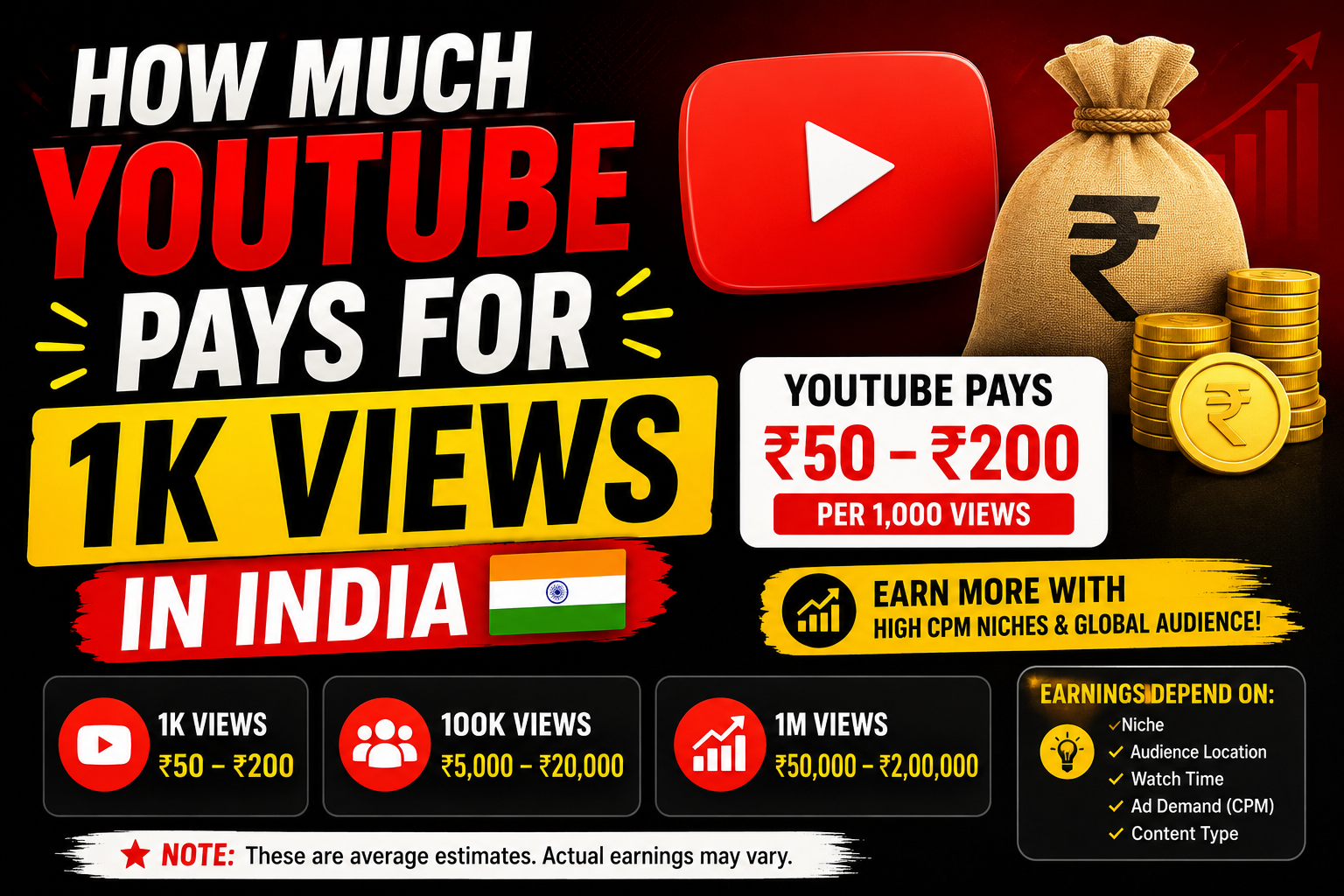
- Many Indian creators report earning roughly ₹20 to ₹150 per 1,000 views on long-form videos, but some niches earn much more and Shorts usually earn less.
- You need to join the YouTube Partner Program before you can earn from ads.
- RPM in YouTube Studio is the most accurate figure for your own channel.
“How much does YouTube pay for 1,000 views in India?” is one of the most searched questions by new creators. The short answer is that it varies a lot. Two channels with the same number of views can earn very different amounts. This guide explains how YouTube pays, typical earnings ranges in India, what affects them, and how to increase your income per view.
Table of Contents
ToggleHow YouTube actually pays creators
YouTube earns money when advertisers pay to show ads on videos. Creators in the YouTube Partner Program receive a share of that revenue:
- Long-form videos: creators receive 55% of the net ad revenue from ads shown on their videos.
- Shorts: ad revenue from the Shorts feed is pooled and shared, and creators receive 45% of their allocated share.
Not every view shows an ad. Some viewers use ad blockers or YouTube Premium (Premium creators earn a share of subscription revenue instead), and advertisers can’t place ads on every video.
CPM vs RPM: the two numbers you need to know
| Metric | Meaning | Who it’s for |
|---|---|---|
| CPM (cost per mille) | What advertisers pay for 1,000 ad impressions, before YouTube’s share | Shows how valuable your audience is to advertisers |
| RPM (revenue per mille) | What you earn per 1,000 video views, after YouTube’s share, from all revenue sources | Shows what you actually take home |
RPM is always lower than CPM, because it counts every view (including those with no ads) and is calculated after YouTube’s share. For planning your income, RPM is the number that matters.
Typical earnings per 1,000 views in India
There’s no official rate, but estimates shared by Indian creators commonly fall in these ranges for long-form videos:
| Views | Estimated earnings (at ₹20–₹150 RPM) |
|---|---|
| 1,000 | ₹20 – ₹150 |
| 10,000 | ₹200 – ₹1,500 |
| 1,00,000 | ₹2,000 – ₹15,000 |
| 10,00,000 | ₹20,000 – ₹1,50,000 |
Treat these as rough guides. Entertainment channels with a mostly Indian audience may sit at the low end. Finance, technology and business channels, or channels with viewers in the US, UK and other high-CPM countries, can go well above the top of this range. Shorts RPM is usually much lower than long-form RPM.
What affects your earnings
1. Niche
Advertisers pay more to reach people who are likely to spend money. Finance, insurance, business software, education and technology usually have higher CPMs. Comedy, vlogs and general entertainment usually have lower CPMs.
2. Audience location
Viewers in countries with higher ad spending, such as the US, UK, Canada and Australia, bring higher CPMs than viewers in India. English-language content can attract a wider international audience.
3. Video length and ad placement
Videos of 8 minutes or longer can include mid-roll ads, which can increase revenue if viewers keep watching. Placing mid-rolls at natural breaks helps avoid losing viewers.
4. Time of year
CPMs tend to rise during big shopping periods, such as the festive season around Diwali and the end of the year, and fall in the first months of the year.
5. Audience age and device
Adults with buying power and viewers watching on TV screens are often more valuable to advertisers.
YouTube Partner Program requirements
To earn ad revenue, your channel needs to be in the YouTube Partner Program. The standard requirements are:
- 1,000 subscribers, and
- either 4,000 valid public watch hours on long-form videos in the past 12 months, or 10 million valid public Shorts views in the past 90 days.
YouTube also offers earlier access to some features, such as memberships and Super Thanks, with lower thresholds in many countries. You also need to follow YouTube’s monetisation policies, live in an eligible country, have an AdSense account and have no active Community Guidelines strikes. Check YouTube Studio’s Earn section for the current rules in your region.
How to calculate your own earnings
- Open YouTube Studio and go to Analytics, then Revenue.
- Find your RPM for the last 28 or 90 days.
- Multiply by your expected views and divide by 1,000. For example, 50,000 views at an RPM of ₹60 is about ₹3,000.
How to earn more per 1,000 views
- Make content for a higher-value topic within your niche, such as “best budget phones for students” instead of general phone news.
- Make videos of 8 minutes or more when the topic deserves it, and add mid-rolls at natural pauses.
- Improve retention, because more watch time means more ad opportunities.
- Consider English or bilingual content if your topic suits an international audience.
- Add other income sources: memberships, Super Thanks, affiliate links, sponsorships and your own products. Many Indian creators earn more from these than from ads.
FAQs
Does YouTube pay for Shorts in India?
Yes, through Shorts ad revenue sharing for Partner Program members. Earnings per 1,000 Shorts views are usually much lower than for long-form videos.
When does YouTube pay?
Earnings are paid monthly through AdSense once your balance reaches the payment threshold for your country.
Is tax deducted?
Google may withhold US tax on earnings from US viewers if you haven’t submitted your tax information in AdSense. Indian income tax rules also apply. Check with a tax professional.
Summary
There’s no fixed YouTube rate per 1,000 views in India. Most long-form creators fall somewhere around ₹20 to ₹150 RPM, with niche, audience location and video length making the biggest difference. Track your own RPM, choose topics advertisers value, keep viewers watching, and build income from more than ads alone.