
TikTok continues to dominate social media in 2026, but its algorithm has evolved significantly. If you’re a creator, marketer, or business owner, understanding how the TikTok algorithm works is no longer optional—it’s essential.
The biggest change? TikTok is no longer about followers or likes. Instead, it’s all about attention, engagement, and relevance. Let’s break down exactly how the new TikTok algorithm works in 2026.
Table of Contents
ToggleWhat Is the TikTok Algorithm?
The TikTok algorithm is an advanced recommendation system that decides which videos appear on your “For You Page” (FYP). Its main goal is simple: show users content they are most likely to watch and enjoy.
Unlike traditional social media platforms, TikTok doesn’t rely on your follower count. Instead, it analyzes your behavior—what you watch, how long you watch, and how you interact.
This means even a brand-new account can go viral if the content performs well.
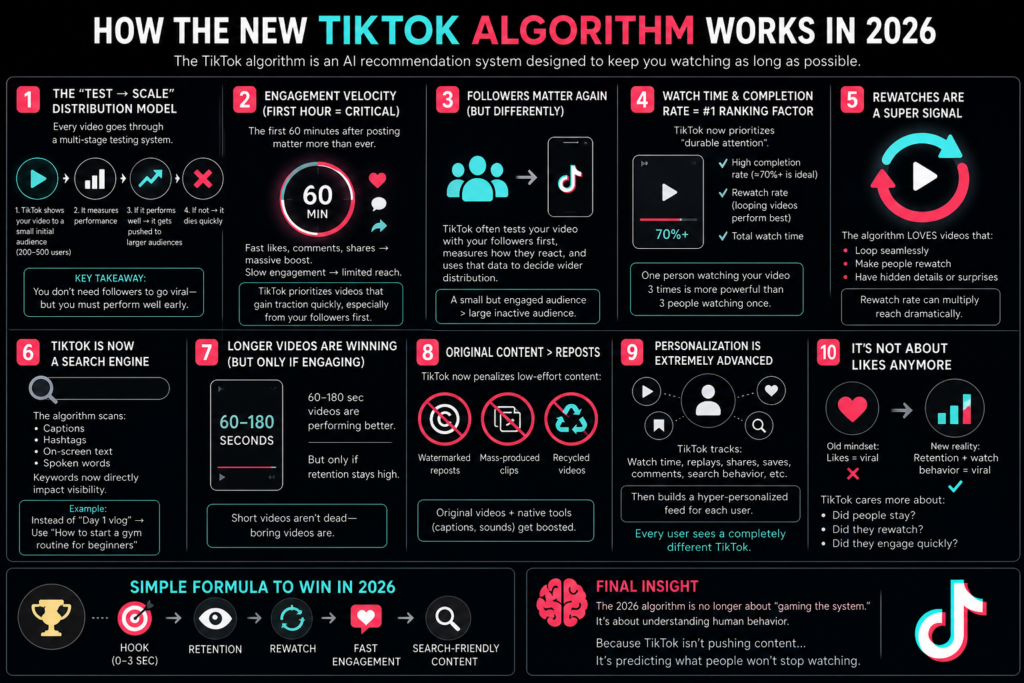
How the TikTok Algorithm Works (Step-by-Step)
Understanding the process behind the algorithm helps you create content that actually gets views.
1. Initial Testing Phase
When you upload a video, TikTok shows it to a small group of users. This audience is selected based on:
- Interests
- Hashtags
- Content type
2. Performance Evaluation
TikTok tracks how users interact with your video, including:
- Watch time
- Completion rate
- Engagement (likes, comments, shares)
3. Content Expansion
If your video performs well, TikTok pushes it to a larger audience. If not, the reach stops there.
4. Continuous Distribution
Videos can continue gaining views over time if they perform consistently well.
This “test and expand” model is the core of TikTok’s growth system.
Key Ranking Signals in 2026
TikTok now evaluates multiple signals, but some matter more than others.
1. Watch Time (Most Important)
Watch time measures how long people stay on your video. The longer they watch, the better.
TikTok prioritizes content that holds attention because it keeps users on the platform longer.
2. Completion Rate
Completion rate is the percentage of people who watch your video until the end.
A high completion rate signals strong content quality. In 2026, videos often need around 70% completion rate to perform well.
3. Rewatch Rate
If users watch your video multiple times, TikTok considers it highly valuable.
Replays indicate:
- Strong interest
- Curiosity
- High entertainment value
4. Engagement (Shares, Comments, Saves)
Not all engagement is equal anymore.
TikTok prioritizes:
- Shares
- Saves
- Meaningful comments
Likes still matter—but less than before.
Why Watch Time & Retention Dominate
In 2026, TikTok is obsessed with one thing: attention.
Videos that:
- Keep users watching longer
- Get replayed
- Are watched fully
…are pushed more aggressively.
This shift means flashy content isn’t enough. You need:
- Strong storytelling
- Fast pacing
- Engaging hooks
The First 30–60 Minutes: Critical Window
The first hour after posting is crucial.
TikTok analyzes early performance signals like:
- Immediate watch time
- Engagement speed
- Viewer retention
If your video gets strong engagement quickly, it’s more likely to go viral.
This is called engagement velocity, and it plays a major role in distribution.
Personalization & the For You Page
TikTok’s biggest strength is personalization.
The platform builds a unique profile for every user based on:
- Viewing history
- Interaction patterns
- Content preferences
This creates a highly customized feed where every user sees different content.
TikTok uses an interest-based system, not a social network model.
Content Distribution Phases
TikTok content typically goes through three stages:
Phase 1: Small Audience Testing
Your video is shown to a small group.
Phase 2: Medium Expansion
If it performs well, it reaches a wider audience.
Phase 3: Viral Scaling
High-performing content is pushed to massive audiences.
If performance drops at any stage, the video stops growing.
Content Factors That Boost Ranking
To succeed on TikTok in 2026, your content must meet certain criteria:
Strong Hook (First 3 Seconds)
If users scroll away quickly, your video will fail.
High Retention Structure
Keep viewers engaged throughout the video.
Loopability
Create content that encourages rewatching.
Original Content
TikTok prefers fresh, unique content over reposts.
Engagement Quality vs Quantity
Not all engagement is valuable.
TikTok now focuses on quality engagement, such as:
- Thoughtful comments
- Shares to others
- Saves for later
This type of engagement shows deeper interest and increases reach.
What TikTok Algorithm Penalizes
Certain behaviors can hurt your performance:
- Low watch time
- Clickbait without delivery
- Reposted videos with watermarks
- Inconsistent content niche
TikTok rewards consistency and authenticity.
Posting Frequency & Consistency
Consistency helps train the algorithm.
Posting regularly:
- Builds audience trust
- Improves performance data
- Increases visibility
However, quality always matters more than quantity.
Posting Frequency & Consistency
Consistency helps train the algorithm.
Posting regularly:
- Builds audience trust
- Improves performance data
- Increases visibility
However, quality always matters more than quantity.
Common TikTok Algorithm Myths
Let’s clear some misconceptions:
Myth 1: Followers Determine Reach
False. Content performance matters more.
Myth 2: Hashtags Alone Make You Viral
Hashtags help—but content quality is key.
Myth 3: Shadowban Is Common
Most “shadowbans” are actually low-performing content.
Advanced Insight: How TikTok AI Thinks
TikTok uses artificial intelligence to predict what users will enjoy.
It analyzes:
- Behavior patterns
- Content similarity
- User preferences
Its goal is to keep users watching longer by delivering highly relevant content.
Final Takeaways
The TikTok algorithm in 2026 is smarter than ever.
Here’s what matters most:
- Focus on watch time and retention
- Create content that people want to rewatch
- Prioritize quality engagement over likes
- Stay consistent and niche-focused
The biggest lesson?
TikTok doesn’t reward creators—it rewards content that holds attention.